Affiliate Disclosure:Kid Sitting Safe is reader-supported. When you buy through links on our site, we may earn an affiliate commission at no additional cost to you. This does not influence our reviews or recommendations — we only recommend products we genuinely believe in.
Car seats have an expiration date. Whether your seat has reached the end of its lifespan, been in a crash, or simply no longer fits your child, you face a question: what do you do with the old one? You cannot simply throw it in the trash without a second thought. Car seats are safety devices, and irresponsible disposal can put other children at risk.
This guide covers car seat recycling, trade-in programmes, and proper disposal. We’ll explain why car seats expire, how to find recycling options, and how to make sure your old seat doesn’t end up endangering another child.
Why You Can’t Just Throw Away a Car Seat
Car seats are complex products: rigid plastic shells, metal frames and hardware, foam padding, fabric covers, and webbing straps all in one unit. That mix of materials makes them difficult to recycle through standard curbside programmes, so most discarded seats end up in landfill.
But the environmental concern is only part of the story. The bigger issue is safety.
Expired or crashed car seats should never be reused, donated, or sold. If you throw away an intact seat, someone might fish it out of the rubbish and try to use it. A seat that’s been in a crash may have invisible structural damage. An expired one may have degraded plastic or stretched harness webbing that won’t hold in a collision.
Proper disposal means rendering the seat unusable before it goes in the bin, or better yet, recycling its components responsibly. Here’s how.
When to Replace Your Car Seat
Before you dispose of a seat, make sure you actually need to. Here’s when replacement is required.
After any crash. NHTSA recommends replacing a car seat after any moderate or severe crash. Even if you cannot see damage, the forces involved can stress the plastic shell and stretch the harness webbing. The only exception is a “minor crash” that meets ALL of these criteria:
- The vehicle could be driven away from the crash site
- The vehicle door nearest the car seat wasn’t damaged
- No passengers sustained any injuries
- No airbags deployed
- There’s no visible damage to the car seat
If your crash doesn’t meet every single one of these conditions, replace the car seat. Check our car seat accident guide for detailed guidance on post-crash replacement.
After the expiration date. Car seats expire, typically 6 to 10 years from manufacture. Plastic degrades over time, especially when it’s exposed to temperature extremes inside a car. You’ll usually find the expiration date stamped on the bottom or back of the seat shell. See our guide on car seat expiration for more details.
After a recall that can’t be fixed. If your seat’s been recalled and the manufacturer can’t provide a repair kit or replacement, it must be disposed of. Register your car seat when you buy it so you’ll receive recall notifications.
When the child exceeds weight or height limits. Every seat has maximum weight and height specifications. Once your child exceeds these limits, it’s time for the next stage, but the old seat may still be usable if it isn’t expired and hasn’t been in a crash.
If the seat has visible damage, missing parts, or unknown history. Cracks in the plastic, frayed harness webbing, or missing hardware make the seat unsafe. Don’t know the complete history of a used seat, whether it’s been in a crash, how it was stored? Don’t use it for your child.
Retailer Trade-In and Recycling Programs
Several major retailers offer car seat trade-in events that accept old seats and provide discounts on new baby gear. These programs handle the recycling for you.
Target Car Seat Trade-In Events
Target hosts popular car seat trade-in events typically twice per year, usually in April and September. The events run for about two weeks.
How it works:
- Bring any old car seat to a participating Target store
- Target accepts seats in any condition: expired, crashed, damaged, recalled
- Drop the seat at the designated location near Guest Services
- Receive a coupon for 20% off a new car seat, stroller, or select baby gear
- Use the coupon in-store or online
Target works with a recycling partner to disassemble and process the seats. This is one of the easiest ways to responsibly dispose of an old seat while saving money on a replacement.
Find current dates: Check the Target Circle app or visit target.com and search for “car seat trade-in” for upcoming event dates.
Walmart Car Seat Recycling
Walmart has offered car seat trade-in events periodically, though less frequently than Target. Previous events have accepted old seats in exchange for gift cards or store credit.
Because Walmart’s program timing varies, check walmart.com or contact your local store to ask about current recycling options. Some individual stores may accept car seats year-round, while others only participate during promotional periods.
Buy Buy Baby
Buy Buy Baby has historically offered car seat trade-in events similar to Target’s program. However, many store locations have closed following the company’s 2023 bankruptcy filing. If you have a Buy Buy Baby store near you, call ahead to check whether they are accepting car seats.
Manufacturer Take-Back Programs
Some car seat manufacturers have their own recycling or trade-in programs:
Britax has offered trade-in events where customers receive discounts on new Britax seats when they return old seats (any brand) for recycling. Check the Britax website for current program availability.
Clek operates a recycling program in Canada and has partnered with recycling facilities in some US regions. Contact Clek directly for information about disposing of your Clek seat.
Other manufacturers may offer similar programs. Check your seat manufacturer’s website or contact their customer service.
How to Recycle a Car Seat Yourself
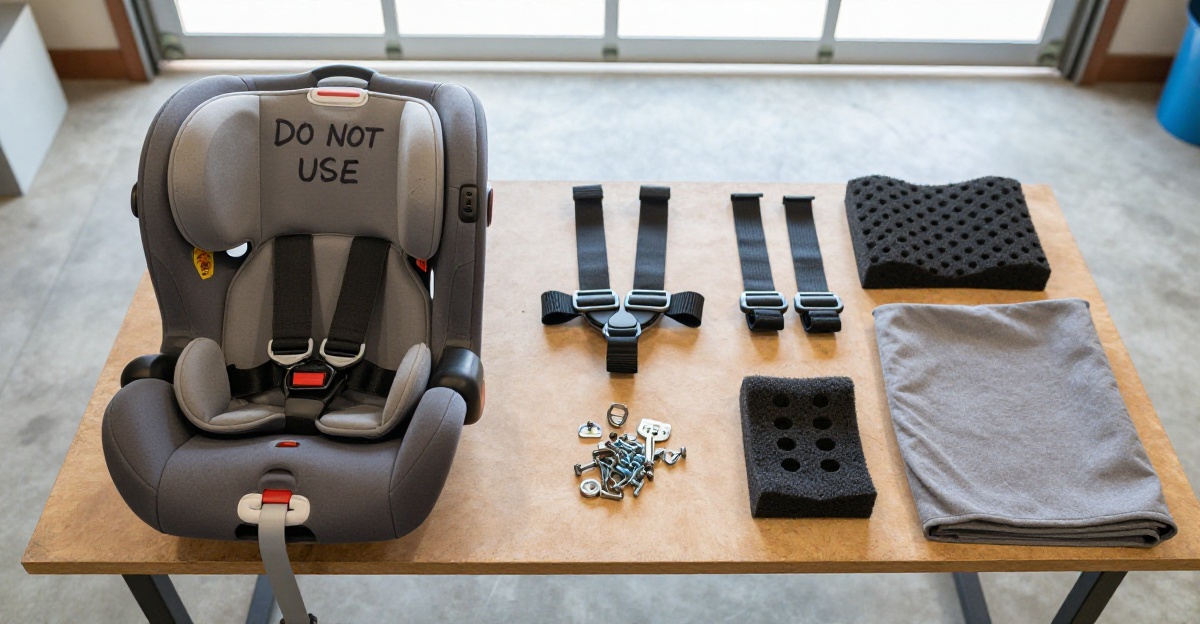
If there’s no trade-in event coming up or you’d rather recycle on your own, you can disassemble the seat and process each component separately. It takes about 20 to 30 minutes and requires basic tools.
Step 1: Remove the Fabric Cover
Most car seat covers are machine washable. Remove the cover by unclipping, unbuttoning, or unsnapping it from the shell. Check the care tag for washing instructions, then either donate the clean cover as textile recycling or discard it if it is worn or stained.
Some recycling centers accept textiles separately from general waste. Earth911.org can help you find textile recycling near you.
Step 2: Remove Hardware and Metal Components
Use a screwdriver or pliers to remove:
- Harness metal connectors and adjusters
- LATCH connector hardware
- Chest clip hardware
- Frame bolts and screws
Place all metal hardware in your standard recycling bin unless your local program requires separation. Most curbside programs accept mixed metals.
Step 3: Separate the Plastic Shell
Most car seat shells are made from #5 polypropylene plastic. Look for the recycling symbol molded into the plastic, usually on the bottom or side of the shell.
Some curbside recycling programmes accept #5 plastic, but many don’t. Check with your local waste management department. If your curbside programme doesn’t take #5 plastic, look for a drop-off location that does.
If you can’t recycle the plastic shell, it’ll go in the bin, but at least you’ve removed the metal and fabric.
Step 4: Remove Foam Padding
Car seat foam is typically polyurethane or expanded polystyrene. Unfortunately, most municipal recycling programmes don’t accept foam padding. It’ll need to go in the bin.
Some specialized recycling facilities accept foam. Use Earth911.org to search for “polystyrene recycling” or “foam recycling” in your area.
Step 5: Dispose of the Harness Straps
Nylon webbing harness straps aren’t recyclable in standard programmes. But you must cut them into pieces before disposal so they can’t be used to reassemble a functional car seat.
Use strong scissors to cut each strap into multiple segments. That way the harness can’t be reattached to create a usable but unsafe seat.
Step 6: Mark the Shell
Before disposing of the plastic shell, use a permanent marker to write “DO NOT USE” or “EXPIRED” or “CRASHED” directly on the plastic. This prevents anyone from retrieving the shell and attempting to use it as is.
How to Properly Dispose of a Car Seat
If recycling isn’t an option where you live, you can put the seat in the bin, but you’ve got to make it unusable first.
Render the seat unusable:
- Cut all harness straps into pieces with scissors
- Remove and discard the padding
- Write “DO NOT USE - EXPIRED” or “DO NOT USE - CRASHED” in permanent marker all over the plastic shell
- If possible, break the plastic shell by hitting it with a hammer or sawing it
Why this matters: An intact car seat in the bin can be retrieved and reused. Someone might take it home, clean it up, and put a child in it. They won’t know the seat’s expired or was in a crash. By destroying it, you’re protecting an unknown child from potential harm.
Disassemble the seat completely if you can. At minimum, cut the straps and mark the shell clearly.
What NOT to Do With an Old Car Seat
Just as important: knowing what you should never do with a car seat you no longer need.
NEVER sell or donate an expired car seat. Materials have degraded, and it may not protect a child in a crash. Selling or donating an expired seat puts another child at risk.
NEVER give away a crashed seat, even to family. Even a minor crash can compromise the seat’s structure. The recipient may not understand the risk, and you could be responsible for a child’s injury.
NEVER leave an intact seat at the curb. Someone will pick it up thinking they’ve scored a free car seat. If it’s expired or damaged, you’ve just put a child in danger.
NEVER buy a used car seat from a stranger. You can’t verify whether it’s been in a crash, whether it has all its parts, or whether it’s subject to a recall. Not worth the savings.
Only exception: you can donate a seat that’s unexpired, has never been in a crash, has all its original parts, and whose complete history you can personally verify to the recipient. Even then, many charities won’t accept car seats due to liability concerns. Always call ahead before attempting to donate.
TerraCycle and Specialty Recycling Services
For families who want to recycle but lack local options, specialty services can help.
TerraCycle has periodically offered car seat recycling programs. When available, you purchase a Zero Waste Box, fill it with your disassembled car seat, and ship it back for recycling. Check terracycle.com for current availability, as programs change.
Local municipal programs vary widely. Some cities accept car seats at special recycling days or household hazardous waste facilities. Call your local waste management department or visit their website to ask about car seat recycling.
Earth911.org is a useful resource for finding recycling facilities near you. Search for “car seat recycling” or specific materials like “#5 plastic” or “textiles” to find drop-off locations.
Choosing a Replacement Seat
If you’re replacing an expired or crashed seat, you’ll need a new one that fits your child’s current stage. For a long-lasting option, consider the Graco 4Ever DLX, a 4-in-1 seat with a 10-year lifespan that grows with your child from birth through booster. View on Amazon to compare pricing.
For families on a tighter budget, the Safety 1st Grow and Go provides reliable safety at an accessible price. It converts through three stages and meets all federal safety standards, solid value for the money. Check Price on Amazon for current availability.
See our guide to top-rated car seats for more replacement options at every price point.
Planning Ahead
Best time to figure this out? Before you actually need to replace the seat. Here’s a summary of your options:
| Situation | Recommended Action |
|---|---|
| Expired seat | Trade-in event or disassemble and recycle |
| Post-crash seat | Disassemble completely, destroy, or trade-in |
| Recalled seat | Follow manufacturer instructions or trade-in |
| Seat in good condition, child outgrown | Donate only if you can verify history to recipient |
| Unknown history seat | Disassemble and dispose |
Key Takeaways
Disposing of a car seat responsibly takes more effort than putting it on the curb, but it’s worth it. A few extra minutes can prevent a dangerous seat from harming another child.
- Never donate or sell an expired or crashed car seat
- Trade-in events like Target’s program are the easiest recycling option
- If recycling yourself, disassemble completely and separate materials
- Always cut the harness straps and mark the shell before disposal
- Check local recycling options through Earth911.org or your waste management department
Handle your old car seat properly and you’re protecting other families while reducing environmental waste. Small effort, big impact.
Recommended Products
Graco 4Ever DLX
Best long-lifespan replacementUltimate budget all-in-one solution for growing families.
What We Like
- 4-in-1 functionality grows with child
- 10-year lifespan from rear-facing to booster
- Simply Safe Adjust harness adjusts from front
- Budget-friendly compared to similar models
What We Don't
- Takes up significant space in vehicle
- Installation requires time and effort to secure properly
Safety 1st Grow and Go
Best budget replacementExceptional value for families watching their budget while prioritizing FMVSS 213 compliance.
What We Like
- Budget-friendly price without sacrificing safety standards
- QuickFit harness for easy height adjustments without rethreading
- Machine washable and dryer safe seat pad
- 10-year usable life span
What We Don't
- Bulkier than premium models
- Lower weight limits in each mode compared to competitors
Sources & Research
Continue Reading
Explore more car seat safety content or browse our other categories.
Frequently Asked Questions
- Can I recycle a car seat that was in a crash?
- You can recycle the materials, but the seat must never be reused. Disassemble it completely, separate metal and plastic components, and recycle each material stream appropriately. Cut the harness straps and mark the shell before disposal.
- Does Target still do car seat trade-in events?
- Yes, Target typically holds car seat trade-in events twice a year, usually in April and September. They accept seats in any condition and provide a 20% off coupon for new car seats, strollers, and select baby gear. Check Target Circle or target.com for current dates.
- Can I donate an unexpired car seat to charity?
- Only if the seat has never been in a crash, has no missing parts, and is not expired. Many charities will not accept used car seats due to liability concerns. Contact the organization first to confirm they accept car seats and understand the requirements.
- How do I find the expiration date on my car seat?
- Check the bottom or back of the car seat shell for a sticker or molded stamp showing the manufacture date and expiration date. Most seats expire 6-10 years after manufacture. If you cannot find the date, contact the manufacturer with your model and serial number.
- Are car seats recyclable in regular curbside recycling?
- No. Car seats are made of mixed materials (plastic, metal, foam, fabric) that cannot be processed together. You must disassemble the seat and separate materials before recycling. The plastic shell is typically #5 polypropylene, which some curbside programs accept.
Written By
Kid Sitting Safe
Our team researches car seat safety standards, crash test data, and real-world usability to help parents make the safest choice.
Related Articles

Car Seat After Accident: When to Replace & Insurance Coverage
Learn when car seats must be replaced after accidents. NHTSA guidelines, insurance coverage options, and how to assess if your seat is still safe to use.
Car Seat Installation: A Complete Guide for Parents
Master car seat installation with our comprehensive guide. Learn LATCH vs. seat belt methods, common mistakes to avoid, and expert tips for secure installation every time.

Car Seat Laws by State: How to Find Yours, and Why the Lists Are Wrong
How to find your state's car seat law and read it properly, why the state-by-state lists in circulation are unreliable, and the three states wrongly listed as requiring rear-facing until age 2.