Affiliate Disclosure:Kid Sitting Safe is reader-supported. When you buy through links on our site, we may earn an affiliate commission at no additional cost to you. This does not influence our reviews or recommendations — we only recommend products we genuinely believe in.
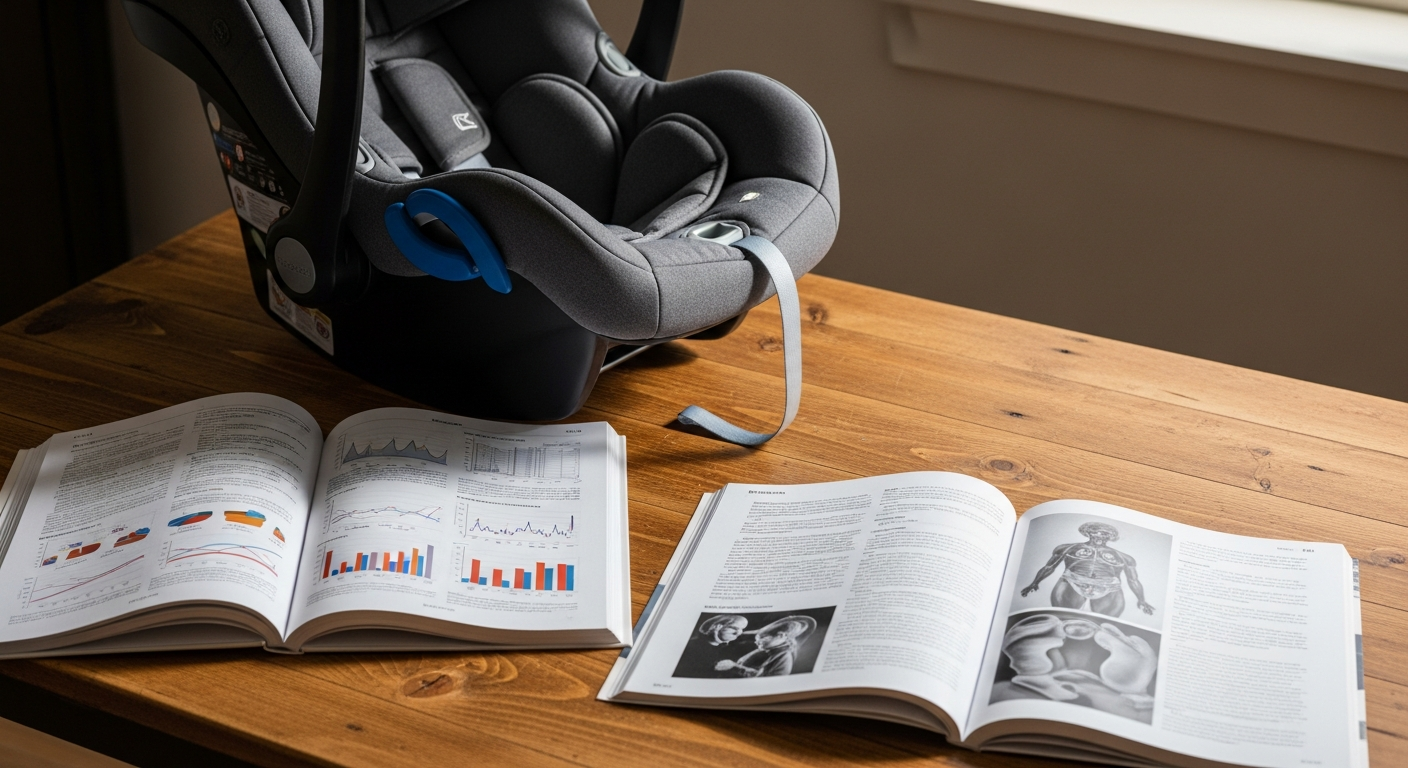
Car crashes are the leading cause of death for children aged 4 and older. Not drowning, not falls - car crashes. That single statistic is at the centre of a 2018 policy statement from the American Academy of Pediatrics. The paper changed how paediatricians, parents, and state legislators approach child restraint.
The headline finding from the paper was this: using the correct car seat cuts the risk of death or serious injury by more than 70%. This is a very significant statistic.
The 5 AAP Car Seat Recommendations at a Glance
- Rear-facing car seat. From birth until the seat’s height or weight limit. No age cutoff.
- Forward-facing car seat with harness. From outgrowing rear-facing through at least age 4.
- Belt-positioning booster. From outgrowing the harness through at least age 8.
- Lap and shoulder seat belt alone. Only once the child reliably passes the seat belt fit test (typically age 10 to 12).
- Rear seat until age 13. Front airbags can cause fatal injuries to children even when properly restrained.
The underlying rule: every transition reduces protection, so delay each one as long as physically possible. Full evidence and source paper details below.
Robert Kay, founder of Kid Sitting Safe, writes: I was slightly obsessive about my daughter’s car seat when she was little. It was during this time that I learned everything I know about car seats. Having the knowledge helped me to know what to check for before every single trip. Read the manual, check the harness tension, get the recline angle just right. This paper tells me that wasn’t paranoia. It’s one of the most protective things a parent can actually do.
Who Wrote It and Why It Matters
Two researchers put their names to this: Dennis R. Durbin, MD, MSCE, from the Children’s Hospital of Philadelphia, and Benjamin D. Hoffman, MD, a paediatrics professor at Oregon Health and Science University. Both are well-established in paediatric injury prevention. They produced the statement on behalf of the AAP’s Council on Injury, Violence, and Poison Prevention, working from decades of crash records, biomechanical research, and large-scale epidemiological data.
This wasn’t a niche academic paper destined for a journal shelf. Its five recommendations now form the foundation of child passenger safety guidance across the US. State lawmakers have drawn on it to update legislation. Paediatricians cite it in well-child visits. It defines what best practice looks like for children riding in cars.
The Big Shift: No More Age-2 Cutoff
The previous AAP position told parents to keep children rear-facing until at least age 2. Durbin and Hoffman scrapped the age threshold entirely. Their updated guidance is straightforward: keep children rear-facing until they hit the maximum height or weight their specific seat allows. That’s it. No age milestone, no birthday to wait for or count down to.
Why? The physics of a young child’s body. Toddlers carry a disproportionately large, heavy head on a neck whose muscles and vertebrae are still developing. Ligaments are more elastic. When a child sits rear-facing, the hard shell of the seat cradles the entire back. Head, neck, spine, all supported together. In a frontal collision (the most common type in serious crashes), impact energy transfers into the seat structure, not the child’s neck.
Flip that same child forward-facing and everything changes. The harness holds the torso. The head is not held. It gets thrown forward with enormous force during a frontal impact, and that force goes straight through the cervical spine. For a two-year-old, that’s exactly the mechanism that causes catastrophic injury.
The data Durbin and Hoffman cited shows car seats reduce injury risk by 71-82% compared to seat belts alone. Most modern convertible seats accommodate rear-facing to 40 or 50 pounds, which means plenty of children can stay rear-facing well past their third birthday.
Every Transition Makes Things Worse
This is the governing principle behind everything in the paper, and it’s the thing most parents don’t instinctively grasp.
Every time a child moves from one restraint stage to the next, protection decreases. Rear-facing to forward-facing harness: less protection. Forward-facing harness to booster: less protection again. Booster to seat belt alone: another step down. Each transition is a measurable reduction in the margin of safety a crash provides.
Parents tend to treat these transitions as milestones. A sign the kid is growing up, something to feel good about. The evidence doesn’t share that sentiment. The seat your child is currently in is protecting them better than the next one up the ladder would. Keep them in it until the manufacturer’s limits are genuinely reached.
The Five Recommendations
1. Rear-facing car seat. From birth until the child reaches the seat’s maximum height or weight limit. No age minimum applies. Keep them rear-facing for as long as the seat will physically allow.
2. Forward-facing car seat with harness. From outgrowing rear-facing through at least age 4. The five-point harness spreads crash forces across the shoulders, hips, and crotch strap. Many seats now accommodate up to 65 pounds or more. Top tethers matter here: the paper found they reduce forward head movement by 4-6 inches during a crash.
3. Belt-positioning booster seat. From outgrowing the harness seat through at least age 8. The booster’s job is geometry: it positions the child so the vehicle’s lap belt sits across the upper thighs and the shoulder belt crosses the chest, not the neck or abdomen. Studies show booster seats reduce serious injury risk by 45% for children aged 4-8 compared to seat belts used without one.
4. Lap and shoulder seat belt. Once a child reliably passes the seat belt fit test. Most children aren’t there until ages 10-12, well past what most state laws require.
5. Rear seat until age 13. Front airbags are engineered for adult occupants. The deployment force can cause fatal injuries to children, even those properly restrained in booster seats.
Nearly Half of All Car Seats Are Used Wrong
Around 46% of car seats were being used or installed incorrectly at the time the paper was published. The part that makes that number worse: most of those parents believed they’d done it right.
The common errors weren’t obscure. Loose harness straps. Wrong recline angle. Twisted chest clips. Belt routed through the wrong path. None of these are trivial. A seat that shifts several inches in a crash because the installation was loose has lost most of its ability to protect the child inside it.
Durbin and Hoffman recommended that paediatricians bring car seat guidance into routine well-child visits and refer families to certified Child Passenger Safety Technicians for hands-on checks. Their conclusion was direct: written instructions and video tutorials aren’t sufficient for many families. In-person verification reduces misuse. If you’re uncertain about your installation, getting it physically checked by a certified technician is one of the highest-return safety actions available to you.
The Gap Between Law and Evidence
At the time of publication, many US states still allowed children to face forward at age 1. Several let kids out of booster seats at 5 or 6. Legal compliance and genuine safety are not the same target.
This gap still exists. Parents who follow state minimum requirements are often moving their children out of each restraint stage years before the evidence says they should. State law sets a floor, a threshold below which you face a fine. It isn’t a safety recommendation. Meeting the legal minimum keeps you legal. That’s all it does.
More states have tightened their laws since 2018, extending rear-facing mandates and raising booster age thresholds. But across many jurisdictions, the disconnect remains.
What This Means for Parents
Durbin and Hoffman didn’t just revise a checklist. They replaced age-based thresholds with a single underlying rule: delay every transition for as long as physically possible, because every transition reduces protection.
The practical application is simple. Don’t treat car seat transitions as achievements. A child who still fits safely in their current seat is better protected than one who’s been moved up because they hit a birthday or a legal minimum. The seat is doing its job. Leave them in it.
Understanding the different types of car seats and how they map to these five stages helps parents think ahead. Pick the right seat at each stage before the current one runs out of room.
This summary does not cover the paper’s detailed crash database methodology, its state-by-state legislative review, or the full biomechanical modelling of spinal injury mechanisms. The full paper and technical report are referenced below.
References
Durbin, D. R., Hoffman, B. D., & Council on Injury, Violence, and Poison Prevention. (2018). Child Passenger Safety. Pediatrics, 142(5), e20182460. https://doi.org/10.1542/peds.2018-2460
Durbin, D. R., Hoffman, B. D., & Council on Injury, Violence, and Poison Prevention. (2018). Child Passenger Safety: Technical Report. Pediatrics, 142(5), e20182461. https://doi.org/10.1542/peds.2018-2461
National Highway Traffic Safety Administration. (2017). Traffic Safety Facts: Children. DOT HS 812 491. https://crashstats.nhtsa.dot.gov
Centers for Disease Control and Prevention. (2023). Child Passenger Safety: Get the Facts. https://www.cdc.gov/child-passenger-safety/prevention/
Arbogast, K. B., Jermakian, J. S., Kallan, M. J., & Durbin, D. R. (2009). Effectiveness of Belt Positioning Booster Seats: An Updated Assessment. Pediatrics, 124(5), 1281-1286.
Continue Reading
Explore more car seat safety content or browse our other categories.
Written By
Kid Sitting Safe
Our team researches car seat safety standards, crash test data, and real-world usability to help parents make the safest choice.
Related Articles
Car Seat After Accident: When to Replace & Insurance Coverage
Learn when car seats must be replaced after accidents. NHTSA guidelines, insurance coverage options, and how to assess if your seat is still safe to use.
Car Seat Installation: A Complete Guide for Parents
Master car seat installation with our comprehensive guide. Learn LATCH vs. seat belt methods, common mistakes to avoid, and expert tips for secure installation every time.

Car Seat Laws by State: How to Find Yours, and Why the Lists Are Wrong
How to find your state's car seat law and read it properly, why the state-by-state lists in circulation are unreliable, and the three states wrongly listed as requiring rear-facing until age 2.