Affiliate Disclosure:Kid Sitting Safe is reader-supported. When you buy through links on our site, we may earn an affiliate commission at no additional cost to you. This does not influence our reviews or recommendations — we only recommend products we genuinely believe in.
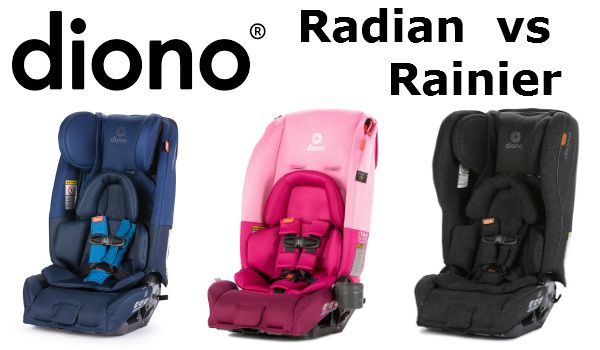
Diono carved out a unique niche with their slim-profile convertible car seats. At just 17 inches wide, the Radian and Rainier can fit three across in vehicles where standard seats fail - an essential feature for growing families.
This comparison examines the differences between these steel-constructed seats and helps you decide which Diono model fits your vehicle and family needs. Both models meet all Federal Motor Vehicle Safety Standard 213 (FMVSS 213) requirements and undergo rigorous testing to ensure crash protection, but they differ in weight limits, comfort features, and price points that can significantly impact your long-term satisfaction.
The Slim Advantage
17-Inch Width
Most convertible seats measure 18-20 inches wide. Diono’s 17-inch profile means:
-
Three seats fit across in many mid-size vehicles
-
More room between seats for comfort
-
Better fit in compact cars
The narrow design addresses a critical pain point for families with multiple young children. According to NHTSA data, proper car seat installation is more likely when adequate space exists between seats - cramped installations increase the likelihood of errors that compromise safety. The Radian and Rainier’s slim profile provides measurable advantages: typically 6-8 inches of additional space across the rear seat compared to three standard-width seats.
This extra space matters beyond just fitting the seats. Parents need room to reach between seats to buckle children, adjust harnesses, and access seat belt buckles. The American Academy of Pediatrics (AAP) emphasizes that proper installation and consistent correct use are as important as the seat itself - a factor directly influenced by how accessible each seat is in your vehicle configuration.
Steel Construction
Both seats feature steel alloy frames rather than plastic, providing superior structural integrity in crashes.
The steel frame construction represents a fundamental design philosophy difference from most convertible seats. While FMVSS 213 doesn’t mandate specific frame materials, Diono’s steel alloy construction offers several advantages:
Structural Benefits:
-
Greater resistance to deformation in severe crashes
-
Reduced flex during side-impact collisions
-
Longer functional lifespan (10-year expiration for both models)
-
Better stability on vehicle seats with less secure surface textures
Practical Considerations:
-
Increased overall weight (28-30 lbs vs 15-20 lbs for plastic-frame seats)
-
Higher manufacturing costs reflected in retail price
-
Greater confidence for parents concerned about long-term durability
The steel construction does create a tradeoff: these seats are significantly heavier than plastic alternatives. Parents who frequently move seats between vehicles or need to carry seats up stairs should carefully consider whether the structural benefits outweigh the daily handling challenges.
Product Comparison
| Feature | Radian 3RXT | Rainier 2AXT |
|---|---|---|
| Width | 17 inches | 17 inches |
| Rear-Facing Limit | 45 lbs | 50 lbs |
| Forward-Facing Limit | 65 lbs | 65 lbs |
| Booster Mode Height Limit | 57 inches | 57 inches |
| Weight | 28 lbs | 30 lbs |
| Side Impact Protection | Standard | Enhanced |
| Padding Type | Standard foam | Memory foam |
| Price Tier | Mid-Range | Mid-Range |
| Expiration | 10 years | 10 years |
| Recline Positions | 3 | 3 |
Head-to-Head Analysis
Rear-Facing Capacity
Rainier Advantage:
The Rainier’s 50-pound rear-facing limit allows extended rear-facing for larger children. Many kids can rear-face to age 4+ in the Rainier.
The AAP recommends that children remain rear-facing as long as possible, ideally until they reach the maximum height or weight allowed by their car seat. Research published in Injury Prevention shows that rear-facing reduces the risk of severe injury by 71-83% compared to forward-facing for children under age 2. The Rainier’s additional 5-pound capacity translates to approximately 6-12 additional months of rear-facing time for children tracking along the 50th percentile for weight.
For context, a child at the 50th percentile typically reaches 45 pounds between ages 4-5, while reaching 50 pounds occurs around age 5-6. This difference becomes particularly relevant for taller children who may exceed height limits before weight limits - the extra rear-facing capacity provides flexibility for different body proportions.
Radian Reality:
The Radian’s 45-pound limit still exceeds most seats and allows extended rear-facing for average-sized children.
Most convertible seats on the market offer 40-45 pound rear-facing limits, placing the Radian 3RXT in the upper range of industry standards. For families with children tracking below the 75th percentile for weight, the Radian’s limit will likely prove sufficient for rear-facing until age 4 or beyond - meeting AAP extended rear-facing recommendations for the majority of children.
The 45-pound limit becomes more restrictive for larger children or those with tall-for-weight proportions. Families with a history of larger children should carefully consider whether the Rainier’s extra capacity justifies the additional cost.
Comfort Features
Rainier Enhancements:
-
Deeper side wing head protection (2 inches deeper than Radian)
-
Premium memory foam padding throughout seat and headrest
-
Higher-quality fabrics with better breathability and stain resistance
-
Enhanced leg rest cushioning for extended comfort
The memory foam padding in the Rainier makes a noticeable difference during longer trips. Memory foam conforms to a child’s body shape, distributing pressure more evenly than standard foam. For children who spend 30+ minutes in the seat regularly (daily commutes, frequent travel), this enhanced comfort can reduce fidgeting and complaints.
The deeper side wings provide additional head containment during sleep - a feature parents particularly appreciate on long drives when children’s heads tend to slump forward or sideways. While not a safety enhancement per FMVSS 213 standards, proper head positioning improves comfort and can indirectly support safer sleep posture.
Radian Approach:
-
Adequate padding for comfort
-
Standard fabrics
-
Functional design
The Radian uses quality standard foam that meets durability requirements but lacks the conforming properties of memory foam. For shorter trips (under 30 minutes) and budget-conscious families, the comfort difference may not justify the Rainier’s premium. Children are remarkably adaptable, and the Radian’s padding provides sufficient comfort for the vast majority of use cases.
Installation Complexity
Both seats share the same installation challenges:
-
Long belt path requires attention to proper threading
-
Proper recline critical for rear-facing (incorrect angles can compromise airway positioning)
-
Expandable sides must be positioned correctly before final tightening
-
Steel frame requires more force to achieve proper tightness
No Difference: Installation difficulty is similar for both models.
NHTSA’s ease-of-use ratings consider installation complexity as a key factor in real-world safety. Both Diono models require more careful attention than seats with simpler installation systems. The steel construction and slim profile create specific challenges:
Seat Belt Installation Considerations:
-
Belt must follow the correct path without twisting
-
Achieving the 1-inch-or-less movement at belt path typically requires significant force
-
Expandable sides can interfere with proper belt routing if not positioned first
-
Vehicle seat angle interacts with car seat recline to affect final installation angle
LATCH Installation:
-
Works well in vehicles with easily accessible lower anchors
-
Steel frame weight can make positioning more difficult than lighter seats
-
Lower anchor weight limit (typically 40 lbs child + seat weight) means seat belt installation necessary for larger rear-facing children
Both seats include angle indicators to help achieve proper recline. Per AAP guidelines, newborns and young infants require a 30-45 degree recline to prevent airway obstruction, while older infants and toddlers can safely use a more upright position. The three recline positions accommodate these requirements, but parents must verify correct angles using the built-in indicators.
Longevity and Extended Use
Both the Radian and Rainier function as convertible seats with three modes: rear-facing, forward-facing with harness, and belt-positioning booster. This extended usability represents significant value compared to seats with shorter lifespans.
Typical Usage Timeline:
-
Birth to 12 months: Rear-facing (after transitioning from infant seat)
-
1-4+ years: Extended rear-facing (varies by child size)
-
4-6 years: Forward-facing with 5-point harness
-
6-8 years: Belt-positioning booster mode
The 10-year expiration date provides flexibility for multiple children. A family with children spaced 2-3 years apart could potentially use one seat through two children’s entire car seat journeys, though many families prefer to maintain separate seats for convenience.
3 Across: Reality Check
Vehicle Compatibility
Diono seats fit 3 across in:
-
Minivans (excellent fit with room to spare)
-
Full-size SUVs (excellent fit)
-
Mid-size SUVs (good fit, measure belt path area)
-
Some sedans (measure first - compact sedans often too narrow)
Specific Vehicle Considerations:
The 17-inch width creates opportunities for three-across configurations, but vehicle-specific factors significantly impact real-world fit:
Seatback Contours: Vehicles with heavily contoured rear seatbacks may reduce usable width even if measurements suggest adequate space. The seats must sit level on the vehicle seat cushion - excessive contours can angle seats inward, effectively reducing the functional width.
Center Seat Belt Configuration: Vehicles with lap-only center belts require careful consideration. While both Diono seats can install with lap-only belts when forward-facing, rear-facing installation requires lap-shoulder belts. Some families solve this by placing the rear-facing seat in an outboard position and using the center for a forward-facing or booster seat.
Buckle Placement: Center seat belt buckles that sit high on the vehicle seat can interfere with car seat bases. Measure buckle height and location before committing to a three-across configuration - some vehicles position buckles in ways that make three-across impossible regardless of seat width.
Space Requirements
Even with narrow seats, you need:
-
Minimum 51 inches of rear seat width at belt path
-
Adequate front-to-back space for rear-facing (generally 28-32 inches from back of rear seat to front seatback)
-
Proper belt/buckle access between seats
-
Room for parents’ hands to reach harness adjustments and buckles
The 51-inch minimum assumes ideal conditions with flat rear seats and accessible belt buckles. Many successful three-across installations actually require 52-54 inches to accommodate buckle access and comfortable child loading.
Front Passenger Space Impact:
Rear-facing installation affects front passenger legroom, particularly in smaller vehicles. The front passenger may need to adjust their seat forward 2-4 inches when a rear-facing Diono seat is installed behind them. Families should test this configuration before purchasing - some adults cannot comfortably accommodate the required front seat adjustment.
Measurement Guide
Measure your vehicle’s rear seat at the belt path (where the seat belts emerge). Three Diono seats need approximately 51 inches.
Proper Measurement Technique:
-
Locate where the seat belt emerges from the vehicle seat on the left side
-
Locate where it emerges on the right side
-
Measure straight across at this level (not along the curved seatback)
-
Account for any obstructions (buckles, cushion contours, armrests)
Many vehicles list rear seat width in specifications, but these measurements often reflect maximum width at the top of the seatback rather than functional width at the belt path level. Always measure your specific vehicle rather than relying on manufacturer specifications.
Real-World Three-Across Combinations
Some families successfully mix seat types to maximize space and functionality:
Common Successful Combinations:
-
Two Diono convertibles (outboard positions) + one narrow booster (center)
-
Two Diono convertibles (one rear-facing outboard, one forward-facing center) + older child without seat (outboard)
-
Three Diono seats in minivans or full-size SUVs with ample space
The key is matching your current needs with your vehicle’s specific dimensions. A family with a 5-year-old, 3-year-old, and newborn might use: Diono rear-facing (newborn, outboard), Diono forward-facing (3-year-old, center), and narrow booster (5-year-old, outboard).
Travel Considerations
FAA Approval
Both seats are FAA approved for aircraft use when forward-facing only (aircraft seats don’t support rear-facing installation).
The FAA approval provides flexibility for families who fly frequently, though practical considerations often limit the usefulness of bringing these specific seats on planes. The FAA requires car seats to fit within airline seat dimensions - typically 16 inches wide for standard economy seats. While the Diono seats theoretically fit at 17 inches, the tight squeeze and installation difficulty make them less than ideal for air travel.
Airlines and Car Seats:
-
Must be installed in window seats (not aisle or most middle seats)
-
Flight attendants may require demonstration of proper installation
-
Overhead bin storage not realistic due to size and weight
-
Gate-checking exposes seats to rough handling
Travel Weight
At 28-30 pounds, Diono seats are heavy for travel. Consider a lightweight travel seat (Wayb Pico at 8 pounds) for air travel.
The weight consideration extends beyond air travel. Families visiting grandparents, taking road trips with multiple vehicles, or needing to move seats frequently between vehicles should carefully evaluate whether the Diono seats match their lifestyle. A 30-pound seat becomes noticeably cumbersome when carrying through airports, up stairs, or between parking lot and vehicle in rain.
Weight Comparison Context:
-
Diono Radian: 28 lbs
-
Diono Rainier: 30 lbs
-
Average convertible seat: 15-20 lbs
-
Lightweight travel seats: 8-12 lbs
-
Infant bucket seats: 8-12 lbs
Many families who choose Diono seats for daily use purchase a separate lightweight seat for travel situations. This approach maximizes the benefits of steel construction for primary use while avoiding the practical difficulties of traveling with heavy seats.
Fold-Flat Feature
Both seats fold flat for storage and transport - a unique Diono feature useful for travel and compact storage.
The fold-flat mechanism allows the seat to collapse to approximately 5 inches thick, making it easier to fit in car trunks, closets, or under airplane seats (though weight remains a factor for airplane carry-on). This feature particularly benefits:
Families with Limited Storage:
When not in use (between children or seasonal storage), the folded seat requires minimal closet or garage space.
Rideshare Situations:
Families using taxis or rideshare services can more easily transport a folded Diono seat, though the weight still presents challenges.
Grandparent Vehicles:
Grandparents who occasionally transport grandchildren can store a folded Diono seat more easily than full-size seats, though many choose even more compact solutions.
Safety Standards and Testing
Both the Radian 3RXT and Rainier 2AXT meet all FMVSS 213 requirements, which mandate specific performance in frontal and dynamic testing. However, understanding what these standards mean helps contextualize how these seats protect children.
Federal Safety Standards
FMVSS 213 requires car seats to:
-
Withstand specific crash forces in dynamic sled testing
-
Limit head excursion (how far the head travels forward) during frontal impacts
-
Maintain structural integrity through repeated use and environmental exposure
-
Include proper labeling and installation instructions
Both Diono models exceed baseline requirements through steel construction that provides additional structural margin. While FMVSS 213 testing uses standardized crash pulses, real-world crashes vary significantly in force, direction, and duration. The steel frame’s resistance to deformation provides safety benefits across a wider range of crash scenarios than minimum testing requires.
Side-Impact Protection
The Rainier’s enhanced side-impact protection includes deeper energy-absorbing foam in the head wings. While FMVSS 213 doesn’t currently mandate side-impact testing for car seats (unlike the voluntary side-impact testing some manufacturers perform), side impacts leave far less crush space between the impact and the child than a frontal collision does.
Side-Impact Safety Features:
-
Deep side wings position energy-absorbing materials closer to child’s head
-
Steel frame resists intrusion from vehicle sides during crashes
-
Head containment reduces head movement toward impact site
The Radian includes standard side-impact protection that meets typical industry expectations, while the Rainier’s enhanced features provide additional margin for families prioritizing maximum protection.
Price and Value Analysis
Cost Comparison Over Time
The Rainier is priced at a modest premium over the Radian. Analyzing this difference through the lens of expected use duration provides perspective:
Assuming 6 years of use (common for convertible seats):
-
Radian: Lower per-year cost over 6 years of typical use
-
Rainier: Slightly higher per-year cost over 6 years of typical use
-
Difference: $8.34 per year or $0.69 per month
When amortized over expected lifespan, the difference becomes less significant than the immediate sticker price suggests. However, families purchasing multiple seats simultaneously (for three-across configurations) see the cost difference multiply:
Three-Seat Purchase:
-
Three Radians: Lower total investment
-
Three Rainiers: a meaningfully higher total
-
Difference: Meaningful savings with the Radian
Budget-conscious families can save meaningful amounts by choosing the Radian, particularly when purchasing multiple seats. The question becomes whether the Rainier’s enhanced features (50-lb rear-facing limit, memory foam, better fabrics) justify the premium for your specific situation.
When the Rainier’s Premium Makes Sense
The upgrade to the Rainier provides clear value for families where:
-
Extended rear-facing is a priority: Children tracking above 75th percentile for weight may outgrow the Radian’s 45-lb limit before age 4, while the Rainier accommodates extended rear-facing longer.
-
Comfort significantly impacts behavior: Children with sensory sensitivities or those spending 45+ minutes daily in car seats benefit noticeably from memory foam padding.
-
Durability through multiple children: Premium fabrics resist staining and wear better through several years and multiple children.
-
Maximum safety features desired: The enhanced side-impact protection provides additional peace of mind for safety-conscious parents.
When the Radian Represents Better Value
The Radian 3RXT offers excellent value for families where:
-
Budget constraints matter: The savings (multiplied across multiple seats) can be allocated to other child safety or family needs.
-
Children track average or below for size: Most children won’t outgrow the 45-lb rear-facing limit before height limits, making the Rainier’s extra capacity unnecessary.
-
Trip durations are moderate: For primarily short trips (under 30 minutes), comfort feature differences become less noticeable.
-
Three-across is the primary priority: When fitting three seats is the main goal and budget is limited, three Radians provide the necessary functionality at lower cost.
Installation Tips for Success
Both seats share installation characteristics that require attention to detail. Following these guidelines improves installation success:
Rear-Facing Installation
-
Position the seat on vehicle seat: Place it where you intend to install it before threading any belts.
-
Adjust expandable sides: Deploy the sides to final width before belt installation - adjusting after belting often requires complete reinstallation.
-
Thread seat belt carefully: Follow the marked belt path precisely. The belt must not twist anywhere along its length.
-
Set recline angle: Use one of the three recline positions. For newborns and young infants (birth to 6 months), use the most reclined setting. Consult the angle indicator.
-
Pull belt tight: The steel frame requires substantial force. Put your knee on the seat and pull the belt as tight as possible.
-
Lock the belt: Engage your vehicle’s seat belt locking mechanism (varies by vehicle - consult vehicle manual).
-
Test for movement: Push and pull at the belt path. Movement should be less than 1 inch in any direction.
-
Verify recline angle: Double-check the angle indicator to confirm proper recline after tightening.
Forward-Facing Installation
Forward-facing installation follows similar steps but requires attention to top tether:
-
Locate top tether anchor: Consult your vehicle manual - anchors vary by vehicle model.
-
Install seat using LATCH or seat belt: Follow the same tightening steps as rear-facing.
-
Attach top tether: Route the tether strap to the anchor point (routing varies by vehicle). Pull tight - the tether significantly reduces forward head excursion in crashes.
-
Test installation: Verify less than 1 inch of movement at the belt path.
The AAP emphasizes that proper installation is crucial for car seat effectiveness. NHTSA’s National Child Restraint Use Special Study put the combined misuse rate for car seats and boosters at 46%, which covers are not installed or used correctly. Understanding the LATCH system can help reduce common installation errors. Taking time to follow instructions precisely significantly improves real-world safety.
Who Should Choose Diono?
Choose the Diono Radian If:
-
You need 3-across capability at minimum cost
-
Budget is a consideration (savings per seat)
-
45-pound rear-facing limit is sufficient for your child’s size trajectory
-
You want the lightest Diono option (2 lbs lighter matters when moving seats frequently)
-
Standard comfort features meet your family’s needs
Choose the Diono Rainier If:
-
You want maximum rear-facing capacity (50 lbs) for extended rear-facing
-
Enhanced comfort features matter for longer daily trips
-
Premium fabrics are important for durability through multiple children
-
Budget allows for the upgrade (modest premium per seat)
-
Enhanced side-impact protection provides additional peace of mind
Consider Alternatives If:
Installation Complexity Concerns: Families intimidated by complex installations might prefer seats with easier installation systems like the Chicco Fit2 or Graco Extend2Fit, which sacrifice some three-across capability for installation simplicity.
Frequent Seat Movement: Parents who move seats between vehicles multiple times weekly should consider lighter seats (Wayb Pico at 8 lbs or Graco SlimFit3 LX at 15 lbs).
Air Travel Priority: Families flying frequently might choose a dedicated travel seat under 12 pounds that fits airline seats more easily.
Budget Constraints: Families needing multiple seats with limited budgets can find seats meeting safety standards at lower price points, though they won’t offer the three-across capability or steel construction.
Decision Summary
| Priority | Best Choice | Reason |
|---|---|---|
| Maximum 3-across value | Radian 3RXT | Lower cost, same width |
| Extended rear-facing | Rainier 2AXT | 50 lb limit vs 45 lb |
| Best comfort features | Rainier 2AXT | Memory foam, premium fabrics |
| Budget-conscious | Radian 3RXT | Savings per seat |
| Lightweight option | Radian 3RXT | 28 lbs vs 30 lbs |
| Premium features | Rainier 2AXT | Enhanced side-impact protection |
| Multiple children durability | Rainier 2AXT | Better fabric wear resistance |
Further Reading
Maintenance and Cleaning
Both Diono models feature removable, machine-washable covers - an essential feature for managing the inevitable spills, accidents, and everyday grime of child transportation.
Cleaning Procedures
Regular Cleaning:
-
Remove cover according to instructions (typically requires removing harness straps)
-
Machine wash cold on gentle cycle
-
Air dry (dryer heat can damage fabrics and elastic)
-
Clean harness straps with damp cloth (never submerge or machine wash straps - this can compromise their strength)
-
Vacuum crevices in the seat to remove crumbs and debris
Accident Cleanup:
-
For vomiting or toileting accidents, clean immediately to prevent odor set-in
-
Use enzyme cleaners for biological accidents
-
Ensure seat is completely dry before reassembly (mold and mildew can develop in damp seats)
The Rainier’s premium fabrics resist staining better than the Radian’s standard fabrics, making cleanup somewhat easier. However, both require regular cleaning maintenance when used by young children.
Head-to-Head Comparison
Detailed Reviews
Diono Radian 3RXT
Best 3 across fitBest slim convertible for fitting 3 across.
What We Like
- Slim 17-inch width fits 3 across in most vehicles
- Steel alloy frame with aluminum reinforced sidewalls for superior safety
- Extended 12-year lifespan from rear-facing through booster
- Folds flat for travel and storage
What We Don't
- Requires top tether for forward-facing installation
- Narrow seat width may be snug for larger toddlers
- Heavy weight makes installation and repositioning challenging
Diono Rainier 2AXT
Best premium slimPremium slim option with enhanced comfort and weight limits.
What We Like
- Higher rear-facing weight limit (50 lbs) for extended rear-facing
- Enhanced head support with memory foam padding
- Same slim 17-inch profile fits 3 across
- Premium fabrics with better breathability
What We Don't
- Higher price point than Radian 3RXT
- Complex installation with multiple adjustment points
- Heavy weight reduces portability
Sources & Research
Continue Reading
Explore more car seat comparisons content or browse our other categories.
Frequently Asked Questions
- What is the difference between Diono Radian and Rainier?
- The Diono Radian and Rainier share the same slim 17-inch profile and steel construction. The main differences are weight limits and features: The Rainier accommodates children rear-facing to 50 pounds (vs. 45 for Radian 3RXT), has enhanced head support with deeper side wings, and uses premium fabrics. The Rainier is priced higher than comparable Radian models. Both fit 3 across in most mid-size and larger vehicles. If you need the absolute highest weight limits and enhanced comfort features, choose the Rainier. If you want the slim fit at a lower price point, the Radian delivers the same core 3-across capability.
- Can Diono seats really fit three across in any vehicle?
- Diono seats are 17 inches wide at the base - the narrowest convertible seats available. However, "fits 3 across" depends on your specific vehicle. Diono seats work well in: minivans (Honda Odyssey, Toyota Sienna), full-size SUVs (Chevy Suburban, Ford Expedition), many mid-size SUVs (Honda Pilot, Toyota Highlander), and some sedans with wide rear seats. They may not fit 3 across in compact cars or vehicles with narrow rear benches. Measure your vehicle's rear seat width at the belt path and contact Diono with your vehicle model for specific guidance. Remember that rear-facing installation requires significant front-to-back space, which may limit 3-across configurations.
- Why are Diono seats so difficult to install?
- Diono seats use a unique design that differs from most convertibles. The low-profile, slim design requires careful attention to: achieving proper recline (especially rear-facing), managing the long belt path, and adjusting the expandable sides. The steel construction and rigid frame provide excellent protection but create a less forgiving installation process. Many parents report needing multiple attempts or professional help (CPST) for their first installation. Once properly installed, Diono seats are very secure. Consider professional installation or watching Diono's detailed installation videos before attempting. The complexity is the trade-off for the slim profile and steel construction.
- Are Diono seats safe despite the complex installation?
- Yes, Diono seats meet all FMVSS 213 safety standards and are rated highly by NHTSA. The steel alloy frame and aluminum reinforced sides provide excellent structural protection. The complexity relates to achieving proper fit, not safety deficiencies. However, car seats only protect when installed correctly, so the installation difficulty is a legitimate concern. If you're not confident in your ability to install a Diono seat correctly, consider: hiring a CPST for installation, choosing a seat with easier installation (Britax ClickTight, Chicco SuperCinch), or practicing installation before your baby arrives. A properly installed Diono is very safe; a poorly installed Diono (or any seat) compromises protection.
- Which is better for travel, Radian or Rainier?
- Both Diono Radian and Rainier fold flat for travel and are FAA approved for aircraft use. The Radian is slightly better for travel because: it's lighter (28 lbs vs 30+ for Rainier), costs less (less financial risk if damaged), and has the same folded profile. Both require significant effort to install on aircraft due to their weight and design. For frequent air travel, consider a lightweight travel seat like the Wayb Pico (8 lbs) instead. If you must choose between Diono models for travel, the Radian offers the same slim fit with less weight and cost.
Written By
Kid Sitting Safe
Our team researches car seat safety standards, crash test data, and real-world usability to help parents make the safest choice.
Related Articles

Britax Boulevard vs Marathon vs Advocate: All Three Are Retired
Britax has retired all three ClickTight convertibles. What separated them, what to check if you own one or are buying secondhand, and which current Britax seat replaces them.
Convertible vs All-in-One Car Seats: Which Should You Buy?
Convertible or all-in-one car seat? A decision-stage comparison covering rear-facing limits, lifespan, value, and which seat fits your family across each stage.
Nuna RAVA vs Britax Poplar S: Premium Convertible Compared
The Nuna RAVA and Britax Poplar S take the same child from 5 to 65 pounds on identical limits. The real differences are the installation system, a rebound bar, two inches of width, and recline range.