Affiliate Disclosure:Kid Sitting Safe is reader-supported. When you buy through links on our site, we may earn an affiliate commission at no additional cost to you. This does not influence our reviews or recommendations — we only recommend products we genuinely believe in.
Quick Picks
Children with special needs often require car seats that go beyond standard retail options. Whether due to physical disabilities, medical equipment, behavioral challenges, or size considerations, adaptive car seats provide the safety and positioning support necessary for safe transportation.
NHTSA’s 2022 children traffic safety facts put it this way: “Child safety seats have been shown to reduce fatal injury by 71 percent for infants under 1 year old and by 54 percent for toddlers 1 to 4 years old in passenger cars.” For children with special needs, the stakes are even higher - improper positioning can lead to respiratory compromise, pressure sores, or inability to tolerate transportation altogether.
This guide covers specialized car seats designed for children with special needs, from complex positioning systems to higher-weight capacity options. Each recommendation is based on specific use cases, as the “best” seat varies dramatically depending on your child’s individual needs, weight, medical conditions, and positioning requirements.
Understanding Special Needs Car Seats
When Are Special Needs Seats Necessary?
Standard car seat types may not work for children who:
- Exceed weight limits of standard seats (over 65-120 pounds)
- Need significant positioning support for trunk control
- Have medical equipment requiring accommodation
- Cannot sit safely in standard configurations
- Have behavioral challenges requiring specialized restraints
- Require custom harness routing to avoid medical devices like g-tubes or tracheostomies
- Experience seizures or muscle spasms that compromise positioning
- Have skeletal abnormalities affecting how standard seats fit
The AAP’s policy statement on transporting children with special health care needs “emphasizes communication among the patient and caregivers, medical team and child passenger safety technicians who have enhanced skills to help transport every child safely and comfortably in a motor vehicle.” The AAP also notes on HealthyChildren that “usually, regular car seats can be used to accommodate the needs of most kids with special health needs”, so the starting question is whether a mainstream seat fits, not which adaptive seat to buy.
Key Differences from Standard Seats
| Feature | Standard Seats | Special Needs Seats |
|---|---|---|
| Weight Capacity | 4-120 lbs | Up to 130 lbs on the seats below |
| Positioning | Basic | Medical-grade options |
| Harness | Standard 5-point | Customizable/modified |
| Medical Equipment | Not accommodated | Designed for integration |
| Cost | Budget to premium | Significantly higher |
| Adjustment Options | Limited | Extensive customization |
| Installation Complexity | Straightforward | Often requires professional |
| Insurance Coverage | Not applicable | Potentially covered |
FMVSS 213 Compliance and Special Needs Seats
All car seats, including those designed for special needs, must meet Federal Motor Vehicle Safety Standard 213 requirements. This standard ensures crash testing and performance criteria are met. However, FMVSS 213 wasn’t designed with special needs populations in mind, which creates challenges:
Aftermarket positioning add-ons that weren’t tested with the seat sit outside what the manufacturer certified, and adding them is not something a parent can verify as safe. Anything of that kind belongs in a conversation with a technician and a therapist, not in a shopping decision.
Medical necessity documentation becomes crucial when modifications are needed. A physician’s letter explaining why standard positioning is medically unsafe is what insurers and school transport teams usually ask for.
The legal gray area: Some adaptive equipment (wheelchair tie-downs with vest restraints, for example) operates under different federal standards. Your CPST should help navigate these distinctions.
Best for Complex Positioning Needs: Roosevelt Car Seat
The Roosevelt is made by Merritt Manufacturing, not Convaid, which is worth knowing because a lot of writing about it (including an earlier version of this page) gets the brand wrong and you’ll struggle to find a dealer searching the wrong name. It sits at the premium tier of special needs car seats, with positioning support that approaches the sophistication of wheelchair seating systems.
Specifications
These are the figures Merritt publish for the Roosevelt:
- Weight range: 35-115 pounds
- Height range: 33.5-62 inches
- Shoulder width maximum: 15.5 inches
- Thigh width maximum: 14.5 inches
- Shoulder strap heights: five positions, 12.5 to 22.25 inches
- Seat height: 30 inches from seat bottom to seat top
- Installation: Merritt’s “EZ-Tether” system, which they say “makes tethering unnecessary in most cases”
Who It’s For
The Roosevelt serves children with:
- Significant trunk weakness (cerebral palsy, muscular dystrophy)
- Traumatic brain injuries affecting posture
- Spina bifida with positioning challenges
- Conditions requiring extensive support
- Post-surgical recovery needs requiring specific positioning
- Scoliosis or spinal fusions requiring custom support
Deep Dive: Positioning Components
These are the options Merritt list on their own product page, in their words where the wording matters:
‘EZ-Up’ Headrest System: “Developed for occupants with poor head control. The Ez-Up head rest offers lateral support. When used with an Ez-Up cap, the Ez-Up head rest system prevents head from falling forward.”
Scoliosis Harness Kit: “Independent bilateral hip adjustors and extra foam pads allow therapists to optimally position the child by filling any gaps behind the child’s back.” Note who Merritt say does the positioning: a therapist, not a parent.
Foam Abductor (pommel): stays in place in use and “pivots away for easy transfer”, for children who need the legs kept apart.
Seat depth extenders: 3-inch and 4.5-inch versions, taking total seat depth to 15.5 or 17 inches, and Merritt say any combination of depths is available so each leg can be supported separately.
‘EZ-Guard’ buckle cover and A-Lok cover: for occupants who release the harness buckle or operate the harness adjuster themselves.
Whether any of this suits a particular child, and how a harness should sit around a g-tube, a central line or any other medical equipment, is a question for the child’s therapist and a technician with special needs training. It isn’t something to settle from a product page, ours or anyone’s.
Installation and Transfer Considerations
Installation is more involved than a retail seat:
- Vehicle compatibility: Not all vehicles accommodate the seat’s footprint. Vans with captain’s chairs work best.
- LATCH vs. seat belt: lower anchors carry a weight limit, so at higher weights you install with the vehicle belt instead. Your manual gives the number for your seat. See our car seat installation guide for general principles.
- Top tether requirements: Always required for forward-facing installation.
- Professional installation verification: Strongly recommended within 30 days of initial setup.
Considerations
The Roosevelt is sold through mobility dealers and usually fitted rather than bought off a shelf. Budget for fitting services and for insurance approval delays; ask your supplier what timeline they’re seeing with your state’s Medicaid programme, because it varies and nobody publishes a reliable national figure. Plan transportation alternatives during the approval period.
Maintenance requirements: Positioning equipment needs regular inspection. Check padding for compression, harness for fraying, and hardware for loosening every three months, and replace foam that no longer rebounds.
Growth management: Unlike standard seats, the Roosevelt accommodates growth through adjustment rather than replacement. Expect to schedule refitting appointments every 6-12 months as your child grows.
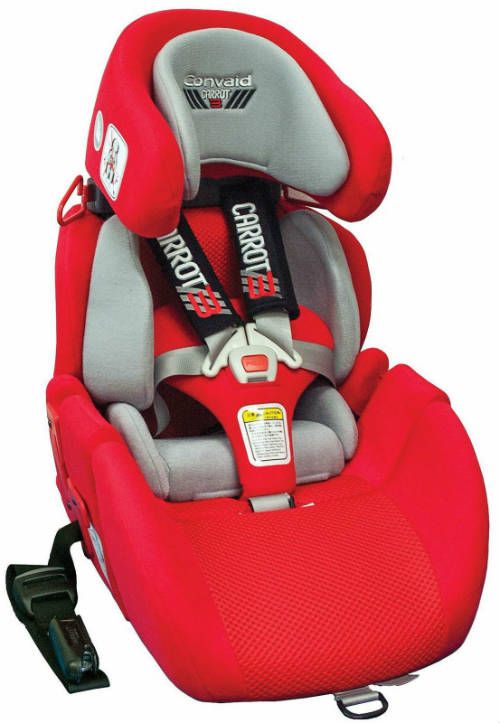
Best Growth Adaptability: Carrot Car Seat
The Carrot 3 offers versatility that grows with your child while providing moderate positioning support. This seat occupies the middle ground between standard high-back boosters and medical-grade positioning systems like the Roosevelt.
Published Range
Etac’s own Carrot 3 page gives a single envelope rather than the staged bands you’ll see repeated on other sites: 30-108 lbs of user weight, roughly 43 to 59 inches of user height, and a product weight of 19.1 lbs. Seat width is 11.5 inches, seat depth 9.8-11.3 inches as standard and extensible with optional extensions, and back height 11.8-12.8 inches, extensible with shoulder wings.
Key Features
- Optional positioning accessories (sold separately in most cases)
- Reclines through 180 degrees from upright, so a child’s angle can be set for the vehicle
- Contoured headrest and body-conforming foam inserts
- Optional shoulder wings for side impact protection
- Accommodates growth through adjustment rather than replacement
- Less institutional appearance - looks more like premium standard seats
- Removable, washable covers (critical for incontinence or feeding challenges)
The Carrot Advantage
For children who will need positioning support for years but don’t require the Roosevelt’s extensive features, the Carrot offers a middle ground with better growth adaptability. Families whose children can use mainstream seats should also consider our best convertible car seat recommendations.
Specific use cases where Carrot excels:
-
Down syndrome: Many children with Down syndrome have low muscle tone requiring support, but not necessarily complex positioning needs. The Carrot provides torso support while accommodating growth from preschool through elementary school.
-
Sensory processing challenges: Some children with autism or sensory processing disorder benefit from the contained feeling provided by the Carrot’s sides without requiring full medical positioning.
-
Developmental delays: Children whose motor skills lag behind their size can stay in the Carrot long after a standard seat would have run out, since it’s rated to 108 pounds against roughly 65 for a mainstream harnessed seat. Check the harness limit on your specific configuration with your supplier, because Etac’s product page doesn’t publish one and the larger Carrot 3 Booster is a different seat with different limits.
-
Recovering from injury: Children recovering from orthopedic injuries who temporarily need more support can transition through Carrot’s stages as they heal.
Positioning Accessories
The Carrot system includes optional add-ons that customize support:
- Lateral supports: Foam or rigid panels that prevent sideways collapse
- Crotch strap: Prevents submarining for children with low tone
- Abductor wedge: Maintains hip positioning for orthopedic needs
- Head support wings: Provides lateral head stabilization without full medical positioning
These accessories allow families to start with basic configuration and add support as needed, avoiding over-equipment initially.
Insurance Considerations for Mid-Level Seats
The Carrot occupies challenging territory for insurance coverage. It’s more expensive than standard seats but less clearly “medical equipment” than the Roosevelt. Documentation that tends to help, though none of it is a guarantee and none of it comes from a published rulebook:
- Emphasizing positioning needs rather than just extended harness use
- Documenting specific medical conditions requiring support (hypotonia, recovery from surgery, etc.)
- Including physical therapist evaluation of positioning needs
- Demonstrating that standard seats failed to meet the child’s needs
The Extended-Harness Gap
There’s a group of children this article has to be honest about, because the market serves them badly.
Who They Are
Children with cognitive or behavioural challenges who can’t safely use a booster despite being big enough for one. A booster only works if the child sits properly for the whole journey: feet flat, back against the seat, belt where it should be. Children with ADHD, autism, intellectual disabilities or impulse-control difficulties may not hold that position consistently, and a belt sitting on a soft abdomen instead of the hip bones is exactly the loading a booster is meant to prevent.
The gap: most standard harnessed seats top out around 65 pounds. Judgement about belt positioning can arrive years after a child passes that weight.
What Actually Fills It
Not much, and you should be sceptical of anything claiming otherwise. Once a child is past the harness limit of a mainstream seat, the options are the medical and special-needs seats covered elsewhere on this page, which is why the Roosevelt, the Carrot and the Spirit Plus all carry harness limits far above the mainstream ceiling. Those come with a funding process and usually a therapist’s assessment, which is a real barrier, and it’s covered in the funding section above.
Some families are pointed towards older extended-harness seats found secondhand. Be careful there. A seat’s expiry date still applies, its crash history is unknowable, and its instructions may be missing. If a therapist has recommended a specific model, ask them to confirm it’s still supported by the manufacturer before you buy one used.
What to Ask For
If your child needs harness security past the mainstream limit, the conversation to have with a therapist or a CPST is about harness weight limit first and positioning support second. Those are different requirements and they lead to different seats. A child who only needs the harness, and no postural support, is a much cheaper problem to solve than one who needs both.
Best Comprehensive Positioning: Spirit Plus
The Spirit Plus by Columbia Medical offers the most comprehensive positioning system available in a car seat format, essentially bringing wheelchair seating technology into vehicle transportation.
Integrated Positioning
- Head support with multiple adjustment points (eight-way adjustability)
- Lateral trunk supports (adjustable width, height, and angle)
- Hip guides and positioning (abduction/adduction control)
- Customizable harness routing (accommodates nearly any medical device)
- Recline: 98 degree seat-to-back angle
- Weight range 25 to 130 pounds
- Height accommodation to 5 ft 6 in
- 5-point harness, with the Plus package adding swing-away hip and trunk supports, an abductor and a seat depth extender over the base Spirit
Note the manufacturer’s name has changed. Columbia Medical is now Inspired by Drive, and the figures above come from their current Spirit Plus product page.
Medical Collaboration
This seat typically requires the most collaboration between:
- Child Passenger Safety Technicians (ideally with Special Needs certification)
- Physical therapists (for positioning prescription)
- Occupational therapists (for functional goals and transfers)
- Medical equipment suppliers (for ordering and fitting)
- Physicians (for medical necessity documentation)
- Sometimes orthotists (for custom components)
When Spirit Plus Becomes Necessary
The Spirit Plus serves the highest-acuity population of children transported in car seats. Typical candidates include:
Complex cerebral palsy: Children with spastic quadriplegic CP often need the full range of positioning options the Spirit Plus provides. Without appropriate support, muscle tone pulls them into asymmetric postures that can restrict breathing, digestion, and circulation during transportation.
Muscular dystrophy progression: As muscular dystrophy progresses, children lose the ability to maintain posture independently. The Spirit Plus can be adjusted as muscle weakness increases, maintaining safe positioning through disease progression.
Spinal cord injuries: Children with spinal cord injuries above T12 typically lack trunk control. The Spirit Plus provides the necessary stabilization while allowing for any remaining voluntary movement.
Multiple system involvement: Children with combinations of physical, respiratory, and digestive challenges need positioning that addresses all systems simultaneously. For example, a child with a tracheostomy and g-tube needs positioning that maintains airway patency while avoiding pressure on the feeding tube site.
The Fitting Process
Spirit Plus fitting is substantially more involved than standard car seat installation:
Session 1 (Evaluation): 60-90 minutes measuring the child, documenting current positioning in wheelchair (if applicable), assessing vehicle compatibility, and determining component needs.
Session 2 (Trial fitting): 90-120 minutes with demo equipment, making adjustments while monitoring the child’s tolerance, physiological responses (oxygen saturation, respiratory rate, comfort indicators), and functional positioning goals.
Session 3 (Final fitting): 60-90 minutes once the ordered equipment arrives, final adjustments, caregiver training on daily use, transfers, harness management, and emergency removal.
Follow-up visits: Every 3-6 months to assess positioning as the child grows or conditions change.
Cost Realities
The Spirit Plus represents a significant investment, with the base seat and positioning components together reaching well into the premium price range. Without insurance coverage, this is a substantial expense. However, when compared to the medical costs of pressure ulcers, aspiration pneumonia from poor positioning, or orthopedic complications from unsupported transportation, the preventive value is substantial.
Insurance coding: ask your supplier which HCPCS code they intend to bill under and get it in writing before the claim goes in. Adaptive car seats have no code of their own, so they’re commonly billed as miscellaneous durable medical equipment (E1399), which is exactly the kind of catch-all code that draws a request for more documentation. Don’t take a code from an article, this one included; the supplier who bills it is the one who has to defend it.
When Budget or Insurance Rules Out a Medical Seat
Some families sit in an uncomfortable gap. Their child needs more support than a mainstream seat gives, but a medical-grade seat is out of reach because insurance said no, or because the household can’t absorb the cost while an appeal grinds on.
This guide used to point those families at the Cosco Incognito Kid positioning seat. Neither Cosco nor Safety 1st lists it any more, and since both are Dorel Juvenile brands and the seat was sold under both names, that closes off both routes to it. None of the boosters in either current range is a positioning seat for children with additional needs, so there’s no like-for-like substitute we can name in its place. If you already own one, the section below on improvised support still applies to it.
What’s left is a process rather than a product, and the order matters.
Appeal before you improvise. A first denial isn’t the end of the process, and appeals backed by a therapist’s assessment and a physician’s letter do get overturned. We can’t put a number on how often, because nobody publishes one for this category of claim. An appeal that takes six weeks is still a better outcome than a year in a seat that doesn’t position your child properly.
Ask a CPST to fit a mainstream seat to your child, not to the category. Plenty of children who look like they need adaptive equipment are served safely by a mainstream harnessed seat with a taller shell, higher harness slots or deeper side wings. Mild low tone, a preference for enclosed seating, or simply being a large child who still needs back support and side containment are all cases where a standard seat may fit well. What a mainstream seat can’t do is accommodate medical equipment, support a child with significant postural challenges, provide lateral trunk support, or maintain positioning for respiratory function. Those needs are the line between a seat and medical equipment, and a technician with special needs training can tell you which side of it your child sits on.
Borrow rather than buy for short gaps. Equipment exchange programmes at children’s hospitals and disability organisations, covered in the funding section, are built for exactly this: a temporary need while an appeal is pending or a child recovers from surgery.
Making Budget Seats Work Safely
When budget constraints require using standard seats with modifications, work with a CPST and therapist to ensure safety isn’t compromised:
Pool noodle positioning: Some families use pool noodles covered in fabric along the sides for additional support. Anything added to a seat that the manufacturer didn’t test with it sits outside what was crash tested, and we’re not going to pretend otherwise. If a therapist and a technician have looked at your child’s seat and agreed to it:
- Keep them away from the harness path (don’t impede proper harness function)
- Ensure they don’t prevent proper installation
- Document therapist recommendation for medical necessity
- Understand this approach lacks crash testing validation
Towel rolls for head support: Small rolled towels alongside the head can prevent excessive lateral movement. Place them outside the harness system, secured to the seat (not floating loose in crash scenarios).
Frequent reassessment: Budget solutions require more frequent safety checks. Verify proper fit monthly as improvised positioning compresses faster than medical-grade foam.
Insurance and Funding
Medicaid Coverage
Medicaid typically covers special needs car seats when:
- Deemed medically necessary (not convenience or preference)
- Prescribed by physician (MD or DO, sometimes NP/PA depending on state)
- Fitted by qualified professional (medical equipment supplier or certified facility)
- Prior authorization obtained (timelines vary by state, typically 2-8 weeks)
- Documentation includes specific medical conditions requiring adaptive equipment
- Diagnosis codes support positioning needs (ICD-10 codes for cerebral palsy, muscular dystrophy, spina bifida, etc.)
State variations: Medicaid is administered at the state level, creating significant variation. Some states readily approve special needs car seats; others require extensive appeals. Early Intervention programs (Part C of IDEA) sometimes fund car seats for children under age 3 when Medicaid denies coverage.
EPSDT coverage: Under Medicaid’s Early and Periodic Screening, Diagnostic and Treatment (EPSDT) benefit, children are entitled to medically necessary equipment. This provides leverage when initial claims are denied - appeals citing EPSDT requirements have higher success rates.
Private Insurance
Coverage varies dramatically. Contact your provider with:
- Specific product HCPCS codes (obtain from medical equipment supplier)
- Physician prescription (detailed letter, not just “car seat”)
- Letter of medical necessity (explaining why standard seats are medically unsafe)
- Therapist evaluation (PT/OT assessment of positioning needs)
- Documentation of failed alternatives (attempts with standard seats that proved unsafe)
Common denial reasons and responses:
“Car seats are not covered under DME benefits” - Response: Cite policy language for “positioning equipment” or “postural support devices” and argue the car seat functions as positioning equipment used in vehicle context.
“This is not medically necessary” - Response: Provide documentation of specific medical risks (respiratory compromise, orthopedic complications, aspiration risk) that positioning prevents.
“Standard car seats are available” - Response: Document specific medical conditions that make standard seats unsafe, with physician attestation.
Appeals: there’s no published success rate for special needs car seat appeals specifically, so treat any figure you see quoted for one with suspicion, including figures we’ve quoted here in the past. What’s true is that a denial is a stage in the process rather than the end of it, and that the appeals which succeed are the ones carrying a therapist’s positioning assessment and a physician’s letter rather than a repeat of the original request.
Alternative Funding
-
Community organizations: Easter Seals, Kiwanis, Rotary Clubs, Lions Clubs often fund disability-related equipment for children. Applications typically require financial need documentation and medical necessity letters.
-
State programs: Title V programs (Children with Special Health Care Needs) in each state may fund car seats. Early intervention programs sometimes cover them for children under age 3.
-
Manufacturer and dealer programs: ask the manufacturer and the dealer directly whether they run any assistance or hardship scheme. We’re not naming specific programmes here because we couldn’t find one published, and a programme that turns out not to exist wastes weeks you don’t have.
-
Grants: Various disability-specific organizations offer equipment grants:
- United Cerebral Palsy affiliates
- Muscular Dystrophy Association
- Spina Bifida Association
- Local disability foundations
-
Crowdfunding: Families increasingly use GoFundMe, CaringBridge, or Facebook fundraisers for special needs equipment. Success rates improve when campaigns include specific equipment details, medical necessity explanation, and cost breakdown.
-
Equipment exchange programs: Some children’s hospitals and CP organizations maintain equipment exchange programs where families can donate outgrown equipment and receive needed items. These programs work best for children needing equipment temporarily (post-surgery recovery, for example).
Getting Properly Fitted
The Team Approach
Special needs car seat fitting requires:
-
Child Passenger Safety Technician (CPST) with special needs certification - this additional certification beyond basic CPST training covers positioning principles, medical equipment accommodation, and working with therapy teams.
-
Physical or Occupational Therapist for positioning guidance - ideally a therapist who already knows your child’s needs from other contexts (wheelchair seating, classroom positioning, etc.).
-
Physician for medical necessity documentation - developmental pediatricians, physical medicine & rehabilitation specialists, and neurologists typically provide the most detailed prescriptions.
-
Equipment Supplier for ordering and adjustments - companies specializing in pediatric adaptive equipment have more experience than general DME suppliers.
-
Sometimes additional team members:
- Orthotist for custom positioning components
- Respiratory therapist if positioning affects breathing
- Feeding therapist if positioning impacts swallowing/aspiration risk
- School nurse or transportation director if school transport is involved
The Process
-
Assessment of child’s needs and measurements: This includes current positioning strategies that work, challenges in other seating contexts, medical equipment that must be accommodated, weight and height measurements, and vehicle measurements.
-
Vehicle compatibility evaluation: Not all vehicles accommodate special needs car seats. Minivans generally work best; compact cars rarely work; SUVs vary by model. Consider vehicle access (side vs. rear doors), seat anchoring points, seat belt geometry, and space for caregiver access.
-
Trial fitting with adjustments: Using demo equipment when possible, the team positions the child, monitors their response, adjusts components, and evaluates safety and comfort. Observe the child’s tolerance over 20-30 minutes if possible - initial comfort doesn’t always predict tolerance during actual driving.
-
Caregiver training on daily use: This covers transfers (from wheelchair or walking), harness application and tightening, positioning component adjustment, emergency removal procedures, and daily equipment checks.
-
Documentation for insurance/preschool/school transport: Create clear documentation of the seating system for all contexts where it’s needed. Include photos, written instructions, and emergency contact information.
Finding Qualified Fitters
Locating CPSTs with special needs training requires specific resources:
Safe Kids Worldwide maintains a directory of certified CPSTs, some noting special needs certification. However, the directory doesn’t always indicate special needs training clearly.
Car-Seat.org forums include discussions where parents share experiences with specific fitters in their regions.
Children’s hospitals with physical medicine and rehabilitation departments often have CPSTs on staff or can provide referrals.
Adaptive equipment suppliers work with CPSTs regularly and can recommend technicians experienced with the seats they supply.
State agencies serving children with special needs sometimes maintain lists of qualified fitters, particularly for families using Medicaid or state program funding.
Red Flags in Fitting Services
Not all CPSTs are equally competent with special needs populations. Warning signs include:
- Suggesting standard seats for children clearly needing adaptive equipment
- Unwilling to consult with therapy team
- Rush fittings without adequate time for assessment
- Not asking about medical equipment or conditions
- Unable to answer questions about specific positioning principles
- Not documenting positioning rationale
- Unfamiliar with insurance documentation requirements
Quality fitters invest substantial time (2-4 hours total across assessment and fitting appointments), ask extensive questions, and collaborate actively with medical team members.
Traveling with Special Needs Car Seats
Air Travel Considerations
Most special needs car seats are too wide for aircraft seats (16-17 inches maximum in most aircraft vs. 18-24 inches for special needs seats). Options include:
Gate-checking the seat: The seat travels in cargo but waits planeside. Request “fragile” and “medical equipment” tags. Photograph the seat before checking to document any damage.
CARES harness: The only FAA-approved child restraint device that isn’t a car seat, the CARES harness works for children 22-44 pounds who can sit independently. It provides torso restraint but no positioning support.
Medical documentation for onboard use: If your child cannot safely sit in an aircraft seat without positioning support, physician documentation of medical necessity sometimes allows gate agents to accommodate special arrangements (empty seat next to you for positioning, for example). This isn’t guaranteed but worth attempting.
Wheelchair passengers: Children who travel in wheelchairs can sometimes remain in their wheelchair (properly secured) during flight on certain aircraft and routes. This requires advance arrangement with the airline’s disability desk (call 2-3 weeks before travel).
Road Trips and Extended Travel
Special needs car seats add complexity to road trips:
Positioning tolerance: Children who tolerate car seat positioning for 30-minute commutes may struggle with multi-hour trips. Plan breaks every 60-90 minutes for repositioning, stretching, and pressure relief.
Medical equipment: If your child uses a feeding pump, oxygen, or suction equipment, ensure battery life covers the full journey plus buffer time. Bring car chargers for all equipment.
Backup positioning supplies: Pack extra positioning accessories (foam wedges, towel rolls, etc.) in case primary components fail or need cleaning.
Documentation for emergency scenarios: If you’re far from home and need medical care, having positioning documentation, equipment manuals, and medical information readily accessible saves time in emergency situations.
Hotel cribs and positioning: If your child also needs positioning support while sleeping, standard hotel cribs won’t suffice. Bring portable positioning equipment or contact hotels in advance about accessibility accommodations.
School Transportation and Special Needs Car Seats
IEP Considerations
Transportation is a related service under the Individuals with Disabilities Education Act (IDEA). State car seat laws apply to all children, but IEP documentation can authorize specialized equipment. If positioning support is required for safe school transportation, it should be documented in your child’s Individualized Education Program (IEP).
IEP language that helps:
- “Student requires positioning support during transportation due to [specific medical condition]”
- “Medical equipment [car seat model] necessary for safe transportation”
- “Transportation team must be trained in positioning system use by qualified professional”
- “Emergency protocols for medical events during transport must include positioning considerations”
School district responsibilities: Once positioning equipment is documented as necessary in the IEP, school districts must provide it. Some districts purchase equipment for school-only use; others require the family’s personal equipment to transfer to school vehicles.
School Bus vs. Personal Vehicle
Not all special needs car seats can be used on school buses:
School bus exemptions: School buses have different safety standards than passenger vehicles. Some states allow secured wheelchairs with appropriate tie-downs; others require FMVSS 213-compliant car seats.
Verification requirements: School transportation directors should verify car seat compatibility with their vehicles and state regulations. Don’t assume the seat that works in your minivan will work on the school bus.
Alternative transportation: Some children require specialized transportation (wheelchair-accessible vans with lifts, smaller buses with appropriate anchor points, or parent transportation with district reimbursement). These alternatives should be discussed during IEP meetings when standard school bus transport isn’t appropriate.
Maintaining and Cleaning Special Needs Car Seats
Routine Maintenance Schedules
Special needs car seats require more maintenance than standard seats:
Monthly checks:
- Harness integrity (fraying, worn stitching)
- Buckle function (clicks firmly, releases appropriately)
- Positioning foam compression (should rebound when pressed)
- Hardware tightness (all adjustment knobs and bolts)
- Cover integrity (tears can lead to positioning failure)
Quarterly checks:
- Installation tightness (seats can loosen over time)
- Padding replacement needs (replace foam that stays compressed rather than rebounding)
- Growth adjustments (headrest height, harness slots, seat depth)
- Vehicle seat wear (indentations from prolonged car seat pressure)
Annual professional inspection: Have a certified fitter inspect the complete system annually, similar to wheelchair maintenance schedules.
Cleaning Protocols
Children with special needs often present more cleaning challenges (incontinence, drooling, feeding issues, medical equipment leaks):
Routine cleaning:
- Remove covers weekly for washing (check manufacturer instructions - most covers are machine washable)
- Wipe hard surfaces with mild soap and water (avoid harsh chemicals that degrade plastic)
- Dry completely before reassembling (moisture trapped in foam promotes mold)
Deep cleaning:
- Every 3-4 months, remove all padding to inspect and clean the shell
- Replace foam that doesn’t rebound or shows permanent compression
- Check for hidden moisture accumulation (mold/mildew in positioning foam)
Biohazard situations:
- For vomit, feces, or blood contamination, use hospital-grade disinfectant
- Consider replacing foam components after significant contamination (cleaning may not fully remove biohazards from foam)
Replacement covers: Most special needs car seat manufacturers sell replacement covers. Having a spare allows continuous use while washing.
Further Reading
- Cybex Car Seat Reviews: German Engineering for Child Safety
- Maxi-Cosi Mico Review: Lightest Premium Infant Car Seat
- Chicco NextFit Review: Best Convertible for Extended Rear-Facing?
Transitioning Out of Special Needs Car Seats
When Do Children Outgrow Special Needs Seats?
The transition timeline varies dramatically:
Weight limits: Once children exceed the manufacturer’s weight limit, alternatives become necessary. The limits vary a lot between seats: 108 pounds on the Convaid Carrot 3, 115 on the Merritt Roosevelt, 130 on the Spirit Plus. Read the label on your own seat rather than a category average.
Height limits: Height restrictions (about 59 inches on the Carrot 3, 62 on the Roosevelt, 5 ft 6 in on the Spirit Plus) may be reached before weight limits for tall, thin children.
Medical changes: Sometimes medical improvements (increased trunk strength, successful surgeries) allow transition to less intensive positioning.
Age and independence: Some teens strongly desire age-appropriate transportation options, even when medical needs still exist.
Alternative Transportation Solutions
When children outgrow car seats but still need positioning support:
Wheelchair transport systems: Vans equipped with wheelchair tie-downs allow children to travel in their wheelchairs. This requires:
- WTORS (Wheelchair Tie-down and Occupant Restraint System) installed in vehicle
- Crash-tested wheelchair (most modern pediatric wheelchairs meet standards)
- Proper training in four-point tie-down procedures
- Occupant restraint separate from wheelchair (lap and shoulder belt)
E-Z-On vests: These are alternative restraint systems that secure children and adults with special needs using vests rather than traditional seat belts. They are child restraints, not medical devices: EZ-ON state on their own site that “all EZ-ON harnesses and vests meet or exceed the National Highway Traffic Safety Administration’s (NHTSA) standards for child restraint systems.” Fitting one is still a job for a technician with special needs training, usually on a therapist’s or physician’s recommendation.
Modified vehicles: Some families ultimately modify vehicles with lifts, lowered floors, or specialized seating systems. These modifications represent a major investment but provide long-term solutions.
Public transit options: In many communities, paratransit systems (ADA-mandated accessible public transportation) provide an alternative once children reach a certain age and functional level.
Our Top Picks
Roosevelt Car Seat by Convaid
Best for complex positioning needsPremium special needs car seat for children requiring significant positioning support.
What We Like
- Weight capacity to 150 pounds
- Medical-grade positioning supports for special needs children
- Crash tested to FMVSS 213 standards
- Adjustable for growth
What We Don't
- Very high price point
- Requires professional fitting and installation
- Heavy and not portable for everyday transfers
Carrot Car Seat by Convaid
Best growth adaptabilityVersatile special needs option with growth capability and moderate positioning.
What We Like
- 3-in-1 design accommodates growth from toddler to youth
- Extended weight range: 22-108 pounds
- Lower profile design than Roosevelt model
- Optional positioning accessories available for special needs
What We Don't
- Premium pricing point
- Limited retail availability - often requires direct order
- May require professional fitting for optimal use
Spirit Plus Car Seat by Columbia Medical
Best comprehensive positioningMost comprehensive positioning system for complex medical needs.
What We Like
- Integrated positioning system for special needs children
- Wide weight capacity range from 35 to 130 pounds
- Modular accessories for customization
- Crash tested and meets FMVSS 213 safety standards
What We Don't
- Very high price point
- Requires professional training for proper installation and use
Sources & Research
Continue Reading
Explore more car seat reviews content or browse our other categories.
Frequently Asked Questions
- What makes a car seat for special needs different?
- Special needs car seats differ from standard seats in several key ways: 1) Higher weight capacities (108 pounds on the Convaid Carrot 3 and 130 on the Spirit Plus, against roughly 65 for a standard harnessed seat), 2) Medical-grade positioning supports including lateral supports, headrests, and harness modifications, 3) Lower profiles for easier transfers, 4) Accommodations for medical equipment like oxygen tanks or feeding tubes, 5) Adjustable components that adapt as children grow or conditions change, 6) Crash testing that accounts for positioning accessories. These seats are designed for children with physical disabilities, developmental delays, behavioral challenges, or medical conditions requiring specialized positioning. They're typically more expensive due to specialized engineering and smaller production volumes.
- Does insurance cover special needs car seats?
- Sometimes. Insurance coverage for adaptive car seats varies significantly by provider and policy. Medicaid typically covers special needs car seats when deemed medically necessary by a physician or therapist, though approval processes can be lengthy. Private insurance coverage varies - some policies include durable medical equipment (DME) coverage that extends to adaptive car seats, while others exclude them. Even with coverage, you may face: prior authorization requirements, specific vendor limitations, partial coverage with significant copays, or lengthy approval timelines. Start by contacting your insurance provider with specific product codes (HCPCS codes) for the seat you're considering. Your child's therapist or physician can help with medical necessity documentation.
- How do I get a special needs car seat properly fitted?
- Proper fitting is critical for both safety and therapeutic benefit. Work with a Certified Child Passenger Safety Technician (CPST) who has special needs training - the standard CPST certification doesn't cover complex medical equipment. You may also need involvement from your child's physical therapist or occupational therapist to ensure positioning supports address specific therapeutic needs. The fitting process typically involves: assessment of child's medical needs and measurements, vehicle assessment for compatibility, trial fitting with adjustments, training for parents/caregivers on daily use, and documentation for insurance if applicable. Contact Merritt Manufacturing (who make the Roosevelt), Etac/Convaid (who make the Carrot), Inspired by Drive (formerly Columbia Medical), or your local children's hospital for referrals to qualified fitters in your area.
- What is the Roosevelt car seat used for?
- The Roosevelt car seat by Merritt Manufacturing is designed for children and young adults with significant positioning needs who have outgrown standard car seats but still require more support than standard seat belts provide. Merritt publish a range of 35 to 115 pounds and 33.5 to 62 inches, and the seat offers positioning options including lateral head support, a foam abductor, seat depth extenders and a scoliosis harness kit. The Roosevelt is often used for children with cerebral palsy, muscular dystrophy, spina bifida, traumatic brain injuries, or other conditions affecting trunk control and positioning. Due to its specialized nature, the Roosevelt is sold through mobility dealers rather than retail, usually requires professional fitting, and is significantly more expensive than standard car seats.
- Can a child with autism use a standard car seat?
- Many children with autism use standard car seats successfully. However, some children with autism may benefit from specialized seats or adaptations due to: sensory sensitivities (texture, pressure, noise), behavioral challenges (unbuckling, eloping), positioning difficulties (low muscle tone, motor planning), or size/weight differences. Solutions range from simple adaptations (seat belt covers for sensory issues, visual schedules for routines) to specialized seats with harness systems that prevent unbuckling. For children who cannot tolerate standard restraints due to sensory or behavioral issues, work with an occupational therapist and CPST to find solutions that balance safety with your child's specific needs. In some cases, a behavioral intervention plan combined with a standard seat is the best approach.
Written By
Kid Sitting Safe
Our team researches car seat safety standards, crash test data, and real-world usability to help parents make the safest choice.
Related Articles
Clek Liing Review: Is This Premium Infant Seat Worth It?
In-depth Clek Liing infant car seat review. We analyze the rigid LATCH, European safety features, and premium construction to see if it's worth the investment.
Nuna RAVA Review: Is This Luxury Convertible Seat Worth It?
Our Nuna RAVA review examines the premium convertible car seat's flame-retardant-free fabrics, extended rear-facing capability, and safety features. Is it worth the investment?
UppaBaby Mesa Review: V2 vs V3 (and Whether Either Is Worth It in 2026)
UppaBaby Mesa V2 vs V3 review for 2026. What changed in the V3, why the V2 is still on sale, where the Mesa wins, and how it stacks up against the Nuna Pipa RX and Clek Liing on independent crash tests.