Affiliate Disclosure:Kid Sitting Safe is reader-supported. When you buy through links on our site, we may earn an affiliate commission at no additional cost to you. This does not influence our reviews or recommendations — we only recommend products we genuinely believe in.
Quick Picks
For active parents, a jogging stroller isn’t optional. It’s the equipment that lets you stay fit while caring for young children. Fixed or lockable front wheels, air-filled tires, suspension systems, hand brakes. Regular strollers have none of this, and they’re genuinely dangerous at running speed.
This guide covers single and double jogging strollers with safety-focused recommendations for parents who won’t compromise on their child’s safety to get a run in.
Quick Comparison: Top Jogging Strollers
| Stroller | Rating | Type | Value | Weight | Best Feature |
|---|---|---|---|---|---|
| BOB Revolution Flex 3.0 | 4.8/5 | Single | Premium | 28.5 lbs | Adjustable suspension |
| Baby Jogger Summit X3 | 4.5/5 | Single | Mid-Range | 28 lbs | Remote wheel lock |
| BOB Revolution Duallie | 4.6/5 | Double | High-End | 33.1 lbs | Independent suspension |
| Graco FastAction LX | 4.3/5 | Single | Budget | 28.2 lbs | Car seat compatible |
| Thule Chariot Cross 2 | 4.5/5 | Double | High-End | 32 lbs | Multisport convertible |
Ratings are our editorial assessment, weighing published specs, manufacturer documentation and independent reviewer consensus. We don’t test products ourselves.
What Makes a Jogging Stroller Different?
Understanding why jogging strollers cost more than regular strollers starts with the engineering.
Fixed Front Wheel Design
The defining characteristic of a true jogging stroller is the fixed or lockable front wheel. Standard strollers use swivel wheels for navigating tight spaces, but at 6-10 mph those wheels become unstable. Dangerous oscillations. A locked front wheel maintains straight-line stability and prevents the shimmy that happens when bumps or weight shifts cause the wheel to flutter.
Pneumatic Tire Systems
Air-filled tires instead of foam or plastic wheels. Pneumatic tires absorb impact, provide better traction on varied terrain, and roll more smoothly at speed. The tradeoff: you’ll need to check tire pressure regularly and occasionally patch or replace tubes.
Advanced Suspension Engineering
Good jogging strollers borrow suspension technology from mountain bikes. Compress and rebound to smooth out bumps, preventing jarring impacts that can be uncomfortable or unsafe for young children whose spines and necks are still developing. Adjustable suspension lets you tune stiffness based on your child’s weight and the terrain you run on.
Braking Systems
Standard strollers have parking brakes. Jogging strollers add hand-activated brakes like bicycle brakes. Speed control on descents without stopping completely. That’s how you maintain running rhythm while staying safe. The hand brake also works as emergency stopping when you encounter something unexpected.
Best Single Jogging Stroller: BOB Gear Revolution Flex 3.0
BOB has dominated the jogging stroller market for years, and the Revolution Flex 3.0 represents their most refined single model.
Superior Suspension System
The mountain-bike style suspension with adjustable shock absorption smooths out bumps that would jolt a baby in lesser strollers. You can dial in the right amount of cushion based on your child’s weight and terrain.
Nine settings from soft to firm. Lighter babies (15-25 pounds) on smooth paths? Soft setting for gentle cushioning. Heavier toddler on rough trails? Firm to prevent bottoming out while still absorbing shocks. This tunability means the stroller performs well from infant stage through the 75-pound limit.
Adjustable Handlebar
The 9-position adjustable handlebar accommodates parents from 5 feet to 6 feet 4 inches - eliminating the back pain and awkward pushing angles that plague fixed-height strollers.
Sounds minor. It’s not. When parents of different heights share a stroller, or when you want different positioning for different activities, the tool-free adjustment takes seconds. Properly positioned handlebars maintain natural arm swing, prevent shoulder hunching, and reduce the lower back strain that builds after miles of pushing at the wrong height.
Swivel/Lock Front Wheel
For everyday use, the front wheel swivels for maneuverability. For running, a simple twist locks it straight - a critical safety feature that prevents the dangerous speed wobble that can occur with unlocked swivel wheels.
Cheaper strollers often have front wheels that nominally lock but still wobble or track at angles, forcing constant correction. Owner reports on the BOB are consistent on this point: the lock holds and the wheel tracks straight, which is the difference between a stroller you can run behind and one you’re correcting the whole way.
Storage and Practicality
Extra-large cargo basket holds 10 pounds of gear. Diaper bags, water bottles, keys, post-run groceries. Multiple pockets keep smaller items organized and accessible mid-run. One-hand recline adjusts the seat for sleeping babies without breaking stride. Oversized UPF 50+ canopy with a peek-a-boo window for checking on your child.
Running Safety Tip: Always lock the front wheel before running. An unlocked swivel wheel can suddenly turn at speed, causing immediate loss of control.
Best Remote Features: Baby Jogger Summit X3
The Baby Jogger Summit X3 distinguishes itself through handlebar-mounted controls that allow adjustments without breaking stride.
Remote Wheel Lock
The handlebar-mounted wheel lock switch lets you transition from swivel to locked mode instantly - no bending down, no stopping. This proves invaluable when your warm-up walk transitions to running, or when switching between sidewalk navigation and trail running during a single outing.
The remote system uses a cable mechanism similar to bicycle gear shifters, so engagement is something you feel and hear rather than something you have to bend down and check. Cable systems do need the same care a bike’s do: keep the housing clean and check the adjuster if the lock starts feeling vague.
All-Wheel Suspension
Many jogging strollers suspend only the rear wheels, but the Summit X3 includes front wheel suspension as well. This creates a noticeably smoother ride across rough terrain, particularly root-crossed trails and deteriorating pavement where the front wheel encounters obstacles first. The suspension travel is modest - this isn’t a mountain biking shock absorber - but sufficient to remove the harsh edge from common running surface imperfections.
Quick-Adjust Canopy
The canopy extends and retracts via a handlebar control, allowing you to provide shade or open the view without stopping. The dual-position system offers moderate coverage for mild sun or maximum extension for bright midday conditions. While not as extensive as the BOB’s canopy, the convenience of handlebar adjustment during runs adds meaningful value.
Handlebar Console
The included parent console features two cup holders and a covered storage compartment for phones, keys, and cards. Bundling it matters more than it sounds: a console designed for the stroller sits tight to the frame, where the generic clamp-on accessories that people buy separately are the ones that rattle for a whole run. The cup holders are deep enough to hold a bottle through jogging motion and open enough to grab without looking down.
Best Budget Option: Graco FastAction Jogger LX
You don’t need to spend a fortune. The Graco FastAction Jogger LX proves that, though some compromises come with the lower price.
Car Seat Compatibility
The FastAction LX accepts Graco SnugRide infant car seats with Click Connect technology, creating a travel system that transitions from car to stroller in seconds. This versatility extends the stroller’s useful life - you can use it from birth with the car seat adapter for walking, then transition to jogging once your baby reaches appropriate age and development.
Great for parents with newborns who want one stroller purchase covering both immediate needs and future running. Car seat locks in with an audible click and releases via a squeeze handle. No tools needed.
Air-Filled Rubber Tires
Graco fits air-filled rubber tires, and they absorb impacts the way foam or plastic wheels don’t. They’re not maintenance-free though. Graco’s manual tells you to check the pressure before every use, inflate with a hand pump only, and stay under the maximum pressure printed on the sidewall, because over-inflating can blow the tire off the rim.
So budget for the odd top-up and an occasional patched tube, same as any pneumatic stroller. What you get back is a ride that isn’t passing every crack in the path through to your child.
Compromises to Consider
At 28.2 pounds it weighs about the same as premium models, but the materials and construction won’t endure years of heavy use as well. Basic suspension. Bushing bearings instead of sealed ball bearings. The frame lacks the refined welding and finish of premium strollers.
Worth knowing about the brakes: Graco’s manual documents foot-operated parking brakes and nothing on the handlebar, so there’s no hand brake to scrub speed on a descent without stopping. If your regular route has hills, that’s the compromise you’ll notice. Less canopy coverage too. Reasonable tradeoffs at this price, but serious runners logging 15+ miles weekly may hit the performance ceiling after a few months.
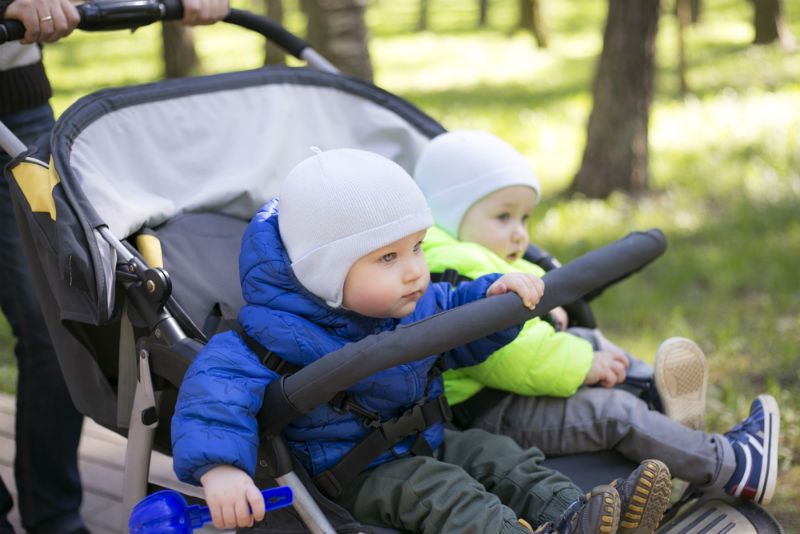
Best Double Jogging Stroller: BOB Revolution Flex 3.0 Duallie
Running with two children presents unique challenges that the BOB Duallie addresses with thoughtful engineering.
Independent Suspension
Each seat has independent suspension - meaning a bump affecting one side doesn’t jolt both children. That matters more than you’d think when one child is sleeping and the other is wide awake.
Separate shock assemblies for each wheel. Right wheel hits a pothole while the left rolls smooth? Only the right-side child feels it. No more waking both kids with every bump.
The suspension adjusts independently too. A 15-pound infant and 40-pound preschooler can ride comfortably with appropriate settings for each side.
Side-by-Side Design
Unlike tandem double strollers that extend length (making running awkward), the Duallie’s side-by-side configuration maintains balanced handling. At 30.5 inches wide, it fits through standard doorways.
Side-by-side preserves your natural gait. Arms push with equal force, body stays centered, weight transfers evenly. Tandem strollers create unbalanced loading that forces constant correction and causes fatigue.
At 30.5 inches wide, it fits through standard 32-inch residential doorways and most commercial entrances. No width issues on trails. Urban runners should know that some narrow store aisles and older building doorways can be tight.
Steering and Maneuverability
Despite the substantial 33.1-pound weight and double-wide track, the Duallie steers better than its size suggests. It carries the same adjustable handlebar as the single Revolution Flex, and owners rarely report the pull to one side that’s a common complaint on lesser double joggers.
Its fixed front wheel locks solidly for running, and the swivel mode navigates parking lots and indoor spaces reasonably well. The turning radius is obviously wider than a single stroller, but the precision steering makes tight situations manageable with practice.
Realistic Expectations for Double Running
Let’s be honest about double stroller running. The 33-pound empty weight plus two kids easily totals 70-100 pounds. Your pace will slow. Hills will hurt. You’ll fatigue faster. The Duallie makes it as pleasant as possible, but physics still applies.
Works best for moderate-pace runs, not speed work. Makes sense if you’re running regularly with two kids. If you only occasionally take both, consider single stroller runs and alternating which child comes along.
Best Multisport Option: Thule Chariot Cross 2
Not just a jogging stroller. The Thule Chariot Cross 2 doubles as a bike trailer, cross-country ski carrier, and hiking stroller.
Modular System Design
Two-child chassis with removable wheels and attachment systems. Jogging kit with fixed front wheel. Bike tow bar. Ski attachment. Each swap takes under a minute with tool-free quick-release mechanisms.
The versatility appeals to outdoor families who do more than just run. And the attachment costs are modest compared to buying separate specialized equipment for each activity.
Premium Construction Quality
Thule’s reputation for roof boxes and bike racks shows in the Chariot’s build quality. Aircraft-grade aluminum tubing, precision welds. Waterproof, UV-resistant fabric that’s removable for washing. Denser padding than typical strollers, comfortable for multi-hour outings.
Weather protection beats dedicated jogging strollers. Full rain coverage, integrated venting, insulation options for cold. Parents doing long trail runs in variable conditions appreciate this over basic canopies and rain covers.
Interior Space and Comfort
The Chariot’s cabin provides more interior volume than side-by-side jogging strollers, with 45 pounds capacity per seat and enough headroom for larger toddlers to sit upright comfortably. Seats recline independently, a lifesaver for nap-time runs when the kids are on different sleep schedules.
Storage includes the main cargo area behind the seats plus multiple mesh pockets for organizing bottles, snacks, and toys. The total storage capacity exceeds what most jogging strollers offer, making the Chariot viable for longer adventures requiring substantial gear.
Running-Specific Considerations
As a pure jogging stroller, it performs slightly below dedicated models like the BOB Revolution Flex 3.0. Suspension is adequate but less refined. Steering takes more effort. And 32 pounds empty is heavy.
The price is steep. But add up separate bike trailers, jogging strollers, and ski solutions. The math favors the Chariot if you’re genuinely using multiple modes. If you’re primarily running, a dedicated jogging stroller is the better buy.
Retired: Thule Urban Glide 2
The Urban Glide 2 held the urban-running slot in this guide for a long time, and Thule has moved on from it. Their jogging category now lists the Urban Glide 3, the Urban Glide 4-Wheel and the Glide 3, with no Urban Glide 2 anywhere on it. If you’re shopping the Thule range, those three are what you’re choosing between, and we haven’t reviewed any of them, so nothing below should be read as a spec for the newer strollers.
Why the Urban Glide earned its slot is still the right checklist for a city runner:
- A hand brake, not just a parking brake. Modulating speed on a descent, or on the approach to a crossing, without coming to a stop is the single feature that makes urban running with a stroller workable. The Urban Glide 2’s lever had an auto-lock, so you could twist and hold it engaged at a crossing rather than squeezing continuously.
- A fold you can do one-handed, and a folded size that fits a normal car boot. The Urban Glide 2 folded to 25.5” x 18.5” x 13” at 25.3 pounds, which is why it suited flats and public transport where a BOB simply doesn’t.
- Big rear wheels on sealed bearings. Its 16-inch rears rolled over cracked pavement, tram tracks and cobbles that smaller wheels transmit straight through to the child, with a slightly smaller 12-inch front for steering.
- Ventilation you can use in traffic. A rear vent window moves air without pointing wind at your child, and a rain cover you can still see through beats the opaque ones.
Check each of those against the current model rather than assuming Thule carried them all forward.
Essential Safety Guidelines
Age Requirements
Never run with babies under 6-8 months old. Their neck muscles can’t handle the bouncing. Walking with a jogging stroller using a car seat adapter is fine for younger babies (see our best infant car seat picks for compatible models), but don’t run until your pediatrician says it’s okay.
The exact age varies by child. Some pediatricians clear robust babies at six months. Others want to wait until eight months or until the baby sits unassisted for extended periods. The critical factor is neck strength: can your baby hold their head steady against vibration and minor impacts?
Preemie babies and children with developmental delays may need more time. Always consult your pediatrician. Manufacturer age recommendations tend to err on the earlier side for marketing reasons.
The Wrist Strap Rule
Every run. Every time. The wrist safety strap goes on your wrist. If you stumble or lose grip, it prevents a runaway stroller. On hills or near traffic, a runaway stroller is genuinely terrifying.
It seems like overkill until you trip on uneven pavement or step in a hole you didn’t see. That momentary loss of balance where you release the handlebar? Catastrophic if the stroller rolls into traffic. Gravity accelerates a runaway stroller to dangerous speeds in seconds.
Thread your hand through the loop so it can’t slide off. Don’t just hold the strap or loop it loosely. When you trip, the startle reflex makes you release whatever you’re gripping.
Wheel Locking Protocol
Before every run:
- Verify the front wheel is locked in straight position
- Test that it doesn’t wobble when you shake the stroller
- Check tire pressure (PSI recommendations are on tire sidewalls)
- Ensure the parking brake is released
This checklist prevents the most common jogging stroller accidents. A wheel that isn’t fully locked will feel fine at first, then release mid-run. Sudden loss of control. The shake test catches incomplete engagement before you’re at speed.
Tire pressure affects handling more than you’d think. Under-inflated: mushy, unpredictable steering and more rolling resistance. Over-inflated: harsh ride and less traction. Check the sidewall for recommended PSI (typically 30-40 for rear, slightly less for front).
The parking brake check seems obvious. But running with a partially engaged brake happens more often than you’d expect. Feels like a rough running surface until you smell burning rubber. Check that the lever is fully released and wheels spin freely.
Visibility Precautions
Running with a stroller makes you less visible and maneuverable to vehicles:
- Use reflective gear and stroller reflectors
- Avoid running in dusk/dawn without lights
- Run facing traffic when on roads without sidewalks
- Cross intersections with extra caution
With a stroller, you’re wider than a solo runner and you can’t jump onto curbs to dodge vehicles. Defensive running is mandatory, especially near traffic.
Reflective materials only work when headlights hit them. In low light without direct illumination, you need active lights. Clip-on LEDs made for cyclists work well on stroller frames. Wear a headlamp or chest light.
Intersections take extra time with a stroller’s momentum and bulk. Start crossing earlier. Make eye contact with drivers. Never assume a vehicle will yield just because you have right-of-way.
Weather Considerations
Temperature matters more than you’d expect. Inside the stroller, with less wind movement, your child experiences a microclimate several degrees warmer than the air around you. Kids can overheat even when you feel comfortable.
Summer: run during cooler morning or evening hours. Sunshade up. Light layers. Water frequently. Touch your child’s neck or back to check temperature (hands and feet are poor indicators of core temp).
Cold weather is the opposite problem. Kids sitting still don’t generate heat like you do while running. Insulated stroller covers and proper layering help, but below 20 degrees F, stroller running generally isn’t advisable regardless of precautions.
Terrain-Specific Recommendations
Trail Running
Serious trail running demands specific stroller features. Both the BOB Revolution Flex 3.0 and Baby Jogger Summit X3 handle moderate trails well, with large wheels, solid suspension, and secure wheel locks. For more aggressive trails, the Thule Chariot Cross 2 steps up with its reinforced frame and mountain-bike-grade components.
Trail running with strollers requires technical skill beyond road running. Root systems, rocks, and sudden elevation changes demand constant attention. The stroller’s momentum on descents builds quickly, making hand brake control essential. Ascending steep grades requires leaning into the stroller and often switching to a power-hike rather than running.
Single-track trails are typically unsuitable for strollers - the width and wheel base exceed most trail widths. Fire roads, double-track trails, and groomed path systems work well. Research trails beforehand to ensure stroller compatibility.
Urban Running
City running emphasizes different features than trail running. Thule’s Urban Glide line built its reputation on exactly that combination: a hand brake for hills, a lighter frame that’s easier to lift onto kerbs, and a compact fold for flats and public transport. The Urban Glide 3 is the current version of it.
Urban running involves frequent stops at intersections, which makes the hand brake particularly valuable. The ability to modulate speed while approaching crosswalks - rather than coming to complete stops - maintains running rhythm and reduces workout interruption.
Sidewalk conditions in cities vary dramatically. Cracked concrete, tree root heaves, and drainage grates create obstacles requiring attention. Larger wheels roll over imperfections more smoothly, but urban runners must remain vigilant for hazards that could catch smaller front wheels.
Track Running
Running ovals on tracks with jogging strollers is possible but awkward. The constant turning in one direction creates uneven loading and can be monotonous. If using tracks, alternate directions each lap to balance the turning forces.
Some tracks prohibit strollers during peak usage times due to space constraints and safety concerns. Check facility policies before planning track workouts with a stroller.
Maintenance and Longevity
Regular Maintenance Tasks
Jogging strollers require more maintenance than standard strollers due to higher speeds and harder use. Weekly tasks include checking tire pressure, inspecting the frame for cracks or loose bolts, and wiping down fabric to prevent mold from sweat and moisture.
Monthly maintenance involves checking brake pad wear, lubricating the wheel bearings, and inspecting the wrist strap for fraying. The brake cables may need adjustment as pads wear - most models include barrel adjusters for maintaining proper brake tension without tools.
Seasonal deep cleaning includes removing fabric components for washing, thoroughly cleaning the frame and wheels, and checking all attachment points and safety mechanisms. This inspection reveals developing problems before they become safety issues.
Tire Maintenance
Pneumatic tires lose pressure gradually and require regular inflation. Keep a floor pump with pressure gauge available and check tires before every run. Small pressure variations significantly affect handling - the difference between 35 PSI and 30 PSI is immediately noticeable in steering response and rolling resistance.
Flat tires happen. Patching or replacing tubes is easy if you’ve ever fixed a bicycle tyre. Carry a spare tube, tire levers, and a portable pump on longer runs in areas without easy access to help. The repair process is identical to bicycle tire repair.
Inspect tires for embedded debris, cracks in sidewalls, and tread wear. Replace tires showing significant wear or damage rather than risking blowouts during runs.
Storage Considerations
Store jogging strollers in dry, covered locations when possible. Prolonged sun exposure degrades fabric and plastics, while moisture promotes rust and mold. If storing outdoors is necessary, use a stroller cover designed for weather protection.
Before long-term storage (winter off-season), clean thoroughly, inflate tires to maximum pressure, and store in a climate-controlled space. The tire pressure maintenance prevents flat spots from developing during stationary periods.
Further Reading
- Best Umbrella Strollers: Top Single & Double Picks for 2026
- Best Car Seat Stroller Combos: Reviews & Buying Guide for 2026
- Best Baby Carriers 2026: Wraps, Soft-Structured & Ring Slings
Conclusion: Choosing Your Jogging Stroller
Which jogging stroller you need depends on how seriously you run, how often, and your budget. Logging 15+ miles weekly? Invest in the BOB Revolution Flex 3.0 for durability and performance that lasts, or look at Thule’s current Urban Glide if you want the hand brake and the compact fold. You can compare prices by shopping for strollers online. These make running with your child genuinely enjoyable.
Casual joggers running 2-3 times weekly on maintained paths? The Graco FastAction Jogger LX works. The compromises are real but manageable for lighter use, and the price savings are substantial.
Two close-aged kids? The BOB Duallie gives the best running experience. For unmatched versatility beyond running, the Thule Chariot Cross 2 earns its premium.
Whatever you choose: wait until your child is developmentally ready. Always use the wrist strap. Lock the front wheel before running. Maintain your stroller. For broader child safety guidance, see our car seat safety guide with 8 essential tips. A jogging stroller lets you stay fit during the demanding years of early parenthood, but only when used correctly.
Our Top Picks
BOB Gear Revolution Flex 3.0
Best single jogging strollerThe gold standard for jogging strollers with unmatched suspension and versatility.
What We Like
- Mountain-bike style suspension provides smooth rides on rough terrain
- Adjustable handlebar accommodates parents from 5'0" to 6'4"
- Locking swivel front wheel converts from everyday use to jogging mode
- Ultra-padded compression seat with infinite recline positions
- Extra-large UPF 50+ sun canopy with magnetic peek windows
What We Don't
- Premium pricing compared to basic jogging strollers
- Heavy at 28 pounds, making it difficult to lift and transport
- Two-step fold process is less convenient than one-hand folds
Baby Jogger Summit X3
Best remote featuresFeature-rich jogger with convenient handlebar controls and excellent suspension.
What We Like
- Remote swivel-lock wheel control on handlebar for easy terrain switching
- All-wheel independent suspension provides smooth ride on rough terrain
- Near-flat recline suitable for comfortable napping
- UV 50+ canopy with peekaboo window protects from sun
What We Don't
- Bulkier fold than competing jogging strollers
- Heavier at 28 lbs makes lifting into vehicles more difficult
- Air-filled tires require occasional maintenance
BOB Gear Revolution Flex 3.0 Duallie
Best double jogging strollerThe only double jogging stroller that doesn't compromise on running performance.
What We Like
- Independent suspension system for each seat provides smooth ride
- 9-position adjustable handlebar accommodates different parent heights
- 30.5-inch width fits through standard doorways
- Individual reclining seats with multiple positions
What We Don't
- Very heavy at 33.1 pounds makes transport difficult
- Premium pricing, at the top of the double jogging stroller tier
- Large footprint when folded
Graco FastAction Jogger LX
Best budget optionBest budget jogging stroller with car seat compatibility for versatile use.
What We Like
- Click Connect compatible with Graco infant car seats
- One-second fold for quick storage
- Air-filled rubber tires for smooth ride on various terrain
- Parent's tray with storage and two cup holders
What We Don't
- Basic suspension compared to premium jogging strollers
- Heavier than some compact stroller options
Thule Chariot Cross 2
Best multisport optionUltimate multisport solution for families who bike, ski, and run together.
What We Like
- Converts to bike trailer, jogger, stroller, and cross-country ski trailer
- Adjustable suspension for different terrain
- Spacious cargo compartment for gear
- Weather-protected cockpit with ventilation windows
- Seats two children comfortably
What We Don't
- Highest price point in category
- Heavy at 35.6 lbs when used as stroller only
- Requires conversion kits sold separately for some modes
Sources & Research
Continue Reading
Explore more strollers content or browse our other categories.
Frequently Asked Questions
- At what age can my baby ride in a jogging stroller?
- Most pediatricians and jogging stroller manufacturers recommend waiting until your baby is 6-8 months old before running with them in a jogging stroller. This allows time for neck muscles to develop sufficient strength to handle the bouncing motion. For infants under 6 months, you can walk with a jogging stroller using a car seat adapter (if compatible), but do not run. Always consult your pediatrician for specific guidance based on your child's development.
- Can I use a regular stroller for jogging?
- No. Regular strollers lack the critical safety features needed for running: a fixed or lockable front wheel that prevents dangerous swivel at speed, large air-filled tires for shock absorption, a hand brake for downhill control, and a wrist strap to prevent runaway stroller incidents. Jogging with a regular stroller can cause loss of control, tip-overs, and serious injury to both parent and child. Always use a stroller specifically designed and labeled for jogging.
- What safety features should I look for in a jogging stroller?
- Essential jogging stroller safety features include: 1) Fixed or lockable front wheel for running stability, 2) Five-point harness for secure child restraint, 3) Wrist strap attached to parent to prevent runaway stroller, 4) Hand brake for speed control on hills, 5) Large air-filled tires (16-inch rear minimum) for shock absorption, 6) Reflective materials for visibility in low light. Additional features like suspension systems and adjustable tracking improve safety and comfort during runs.
- How do I lock the front wheel for jogging?
- Most jogging strollers have a swivel front wheel for maneuverability that must be locked straight for running. The locking mechanism is typically a lever or button near the front wheel. Some models like the Baby Jogger Summit X3 have a remote lock on the handlebar. Always verify the wheel is fully locked and doesn't wobble before starting your run. An unlocked front wheel can suddenly swivel at speed, causing an immediate crash.
- Can jogging strollers be used for everyday walking too?
- Yes, but with caveats. Jogging strollers are heavier and bulkier than regular strollers, making them less convenient for everyday errands. The fixed front wheel (when locked) makes tight turns difficult in stores. However, with the front wheel unlocked for swivel mode, jogging strollers work well for walking. Many active parents use their jogging stroller as their primary stroller, accepting the trade-offs for the versatility of being able to run when desired.
Written By
Kid Sitting Safe
Our team researches car seat safety standards, crash test data, and real-world usability to help parents make the safest choice.
Related Articles
UPPAbaby Vista vs Nuna MIXX Stroller: Premium Stroller Showdown
We compare the UPPAbaby Vista V2 and Nuna MIXX Next strollers side by side. Which premium stroller offers better value, features, and expandability for your family?
Best Strollers for Newborns 2026: From Budget to Premium
Newborns need strollers with full recline, head support, and car seat compatibility. We review the best options from UPPAbaby, Chicco, Graco, and Baby Jogger across travel systems, bassinet strollers, and budget picks.
Best Double Strollers 2026: Side-by-Side and Tandem Picks for Two
We compared the top double strollers of 2026 to find the best options for twins and siblings. Compare jogging, tandem, and side-by-side models from BOB, UPPAbaby, Thule, and more.